
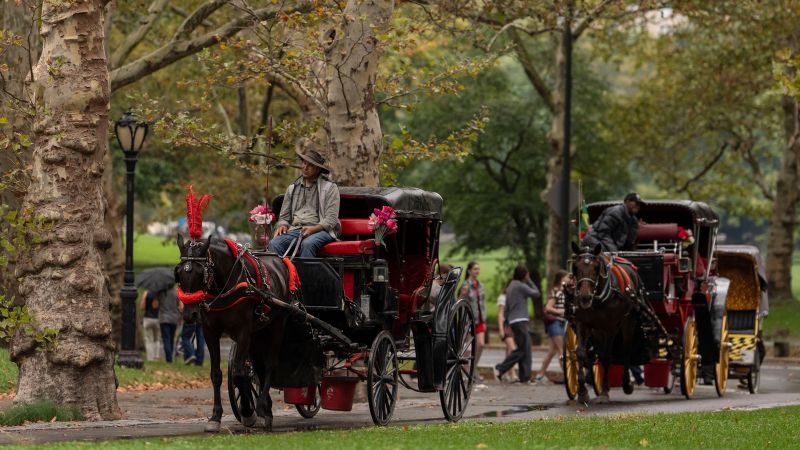
Central Park carriage industry faces an uncertain final chapter
Qwenews.com – New York City is preparing to bring an end to horse-drawn carriage rides in Central Park, a change that could close a chapter of city life that has lasted for more than 150 years. The rides have long drawn visitors seeking a traditional park experience, while animal welfare advocates have spent years pushing for their removal.
For the drivers who rely on the industry, the proposed ban raises an immediate and deeply personal question: how will they continue supporting themselves and their horses once the work disappears?
The City Council was expected to approve legislation Thursday that would prohibit horse-drawn carriage rides by June 2028. The effort gained renewed force after the death of 18-year-old Indian tourist Romanch Mahajan, who died last spring after jumping from a runaway carriage during a ride. His death appeared to be the first fatal incident connected to a Central Park horse carriage since the rides began.
A transition plan still taking shape
More than 150 drivers remain in the carriage business. Under the legislation, Mayor Zohran Mamdani’s administration would have until next April to create a workforce-transition plan for those employees. The plan is expected to include career counseling and referrals for jobs in transit, hospitality and taxi-related fields. It also gives the city room to consider financial compensation for workers affected by the ban.
City Hall has begun discussions about possible compensation while developing a more detailed transition strategy, a spokesperson for the mayor said. Mamdani has argued that the city carries a responsibility to avoid abandoning people whose work is being eliminated.
“No one can come up with an appropriate answer because there is none,” said Alexus Lawson, a 28-year-old carriage driver from Queens.
Lawson grew up around horses, worked as a riding instructor and now worries about the future of Starlight, her 7-year-old horse, along with the other horses in her care.
“Without a job, how can I take care of my horses?”
The concern extends beyond finding another paycheck. Carriage drivers must also consider where the animals will go, how they will be cared for and whether their businesses can survive during the transition. The proposed law addresses employment assistance, but many workers say it has not yet answered the practical financial questions that will arrive before 2028.
Drivers see a familiar threat to their livelihoods
Medet Fidan, 56, said the looming ban feels especially painful after his earlier career as a taxi driver was disrupted by ride-hailing apps. He exchanged a steering wheel for reins, only to face another potential loss of work.
“I think the city is leaving us a big mess,” Fidan said. “We’re going to lose our businesses, we’re going to lose our jobs, we’re going to lose our livelihoods.”
Carriage drivers have expressed sympathy for Mahajan’s family while maintaining that one accident should not bring down an entire industry. Christina Hansen, a longtime driver and spokesperson for the industry, said workers need concrete support rather than broad assurances.
“It does nothing for alternate employment, for the continuation of our businesses,” Hansen said. “Who’s going to pay my rent while I’m looking for a job?”
The union representing carriage drivers has pledged to challenge the measure in court as soon as it becomes law, signaling that the debate may continue well beyond the Council vote.
A safety debate sharpened by tragedy
Mahajan’s relatives have urged city leaders to stop the rides, describing their grief in public testimony and at rallies. The family said they believed the attraction was safe before the fatal incident.
At a Thursday rally alongside local lawmakers and animal welfare advocates, Mahajan’s uncle, Gaurav Mahajan, described the proposed ban as a long-awaited response to the family’s loss.
“The hour of justice has finally arrived,” he said.
“We’re turning our shattering loss into an unbreakable shield of kindness for the city. For months, our family hasn’t been allowed to just grieve,” he said. “We’ve had to fight. We’ve had to channel our devastating sorrow into a war for change.”
Supporters of the ban argue that Central Park has changed and that horse carriages no longer fit comfortably alongside crowds of walkers, cyclists, dog owners and tourists. Council Speaker Julie Menin said displaced employees must receive protection, while also arguing that horses no longer belong in the park’s increasingly busy environment. Her office said she intends to remain involved as the city develops its transition plan.
A long-running political battle
Efforts to end the carriage industry have failed before. Bill de Blasio entered office promising to halt the rides on his first day as mayor, but his campaign commitment collapsed amid union resistance and a high-profile media campaign that included actor Liam Neeson. Eric Adams later raised the prospect of a ban near the end of his mayoralty, but that proposal did not advance.
The latest legislation has also drawn opposition from President Donald Trump, whose Trump Tower stands near Central Park. He called carriage rides “a quintessential New York experience” and lamented their possible disappearance on social media.
“It was a Great Tradition. Another piece of History that’s gone. It will be missed!” Trump wrote.
By June 2028, the city could see the final carriages leave Central Park. Yet the outcome for drivers, business owners and horses remains unsettled. The Council’s action may resolve the question of whether the rides continue, but the harder work will be determining whether the people whose lives are tied to them receive a viable path forward.
Related Reading
Frequently Asked Questions
What is Facing a ban on horse drawn?
Facing a ban on horse drawn is the main topic of this guide. The article explains the context, practical details, and next steps readers should understand.
Why does Facing a ban on horse drawn matter?
Facing a ban on horse drawn matters because readers are looking for a useful answer, not just a short summary. Good content should match search intent and help them decide what to do next.