
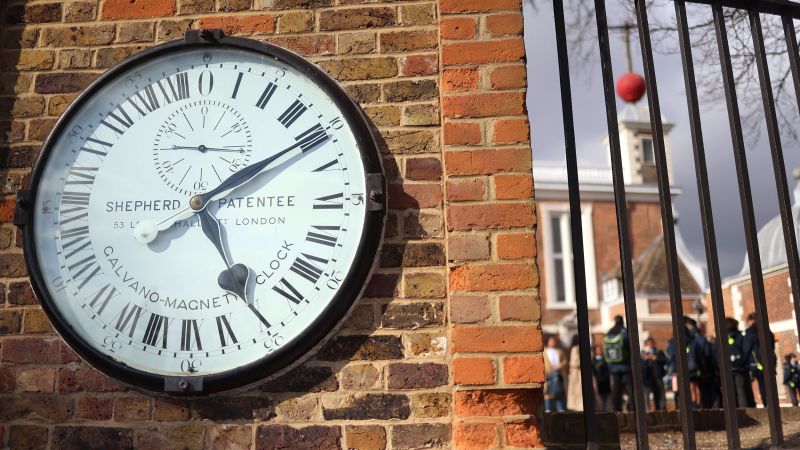
Qwenews.com – Earth s rotation is notoriously wobbly, which is why the world’s most precise clocks do not rely on the planet alone. For centuries, time was tied to the sun’s position above places such as the Royal Observatory Greenwich in London. Today, however, atomic clocks provide a far steadier global standard.
International timekeepers are considering whether to end the leap second, the occasional adjustment used to keep atomic time aligned with astronomical time. The decision could reshape how UTC, or Coordinated Universal Time, is maintained for computers, telecommunications networks, power systems and other critical infrastructure.
Why Earth’s uneven spin creates leap seconds
Earth s rotation is notoriously irregular because the planet does not turn at a perfectly constant rate. The moon’s gravitational pull, changes deep within Earth’s core, and the movement of water and ice across the surface can all affect the length of a day. Melting polar ice may also contribute to those variations.
Atomic clocks measure time through the extremely regular vibrations of atoms, making them much more reliable than Earth’s changing rotation. Leap seconds have acted as a compromise between these two systems, allowing global clocks to stay close to the time indicated by the sky.
Since 1972, 27 leap seconds have been inserted into UTC. Most people never notice them, but they can create major technical challenges because they arrive at irregular intervals and are announced only six months in advance.
Why technology companies want a continuous time scale
A leap second can confuse systems built to process time in a continuous sequence. Data servers, financial trading platforms and booking systems may struggle when a minute contains an unexpected extra second. In 2012, a leap second contributed to disruptions involving Reddit, LinkedIn and Qantas’ booking system.
When the most recent leap second was added at the end of 2016, some Cloudflare customers experienced delays or outages after servers failed to handle the adjustment correctly. Technology companies including Meta have argued that the leap second creates unnecessary risk for modern infrastructure.
The International Bureau of Weights and Measures, known as BIPM, brings together 69 member states to set measurement standards. Its members are set to consider a proposal that would remove the leap second and introduce a continuous form of Coordinated Universal Time, potentially taking effect in May 2027.
A change decades in the making
Officials have discussed ending leap seconds for more than 20 years. At a 2022 meeting, BIPM member countries supported a resolution calling for a plan to phase them out on or before 2035.
Support for the change reflects the rise of satellite navigation and digital systems. When atomic time was introduced, maintaining a link to astronomical time mattered more because navigation relied heavily on celestial observations. GPS and other modern satellite systems have reduced that dependence.
Not every country has supported abandoning the adjustment. Russia previously objected because its GLONASS navigation system incorporates leap seconds, unlike the United States’ GPS and the European Union’s Galileo system.
FAQ: What would ending the leap second mean?
Would clocks suddenly change?
No. Everyday clocks would continue to display hours, minutes and seconds in the familiar way. The proposed change concerns how the global time standard is adjusted behind the scenes.
Why does Earth s rotation is notoriously variable?
Earth’s rotation changes slightly because of gravitational forces, activity within the planet and shifting masses of water and ice. Those small changes add up over long periods, making Earth less stable as a clock than atomic time.
Would astronomical time disappear?
No. Astronomical observations would still measure Earth’s rotation. The proposed change would simply stop using leap seconds to keep UTC continuously synchronized with that rotating reference.
The debate is ultimately about whether the world should prioritize a direct connection to the sky or the uninterrupted precision required by modern technology.