
Narges Mohammadi’s Memoir Reveals Abuse in Iranian Prison
Qwenews.com – Nobel laureate Narges Mohammadi s memoir documents alleged abuse, isolation and medical neglect during her imprisonment in Iran. The Nobel Peace Prize winner says she knows that speaking publicly about her experiences could lead to further consequences, but believes it is vital to expose the treatment of detainees.
Mohammadi, 54, was released from Tehran’s Evin prison in May on temporary medical leave. Her book, A Woman Never Stops Fighting, draws on writing she secretly sent from prison and is scheduled for publication this month in parts of Europe.
Writing from prison despite the risks
For years, Mohammadi depended on friends and fellow prisoners to help move handwritten pages beyond prison walls. She said the process placed everyone involved at risk. During one visit, a friend who attempted to leave with three pages had the material confiscated by security officials.
She also said she lost more than 20 notebooks after being severely beaten and transferred to another prison. Still, she continued writing. Nobel laureate Narges Mohammadi s memoir names people she holds responsible for abuse and describes methods she says are used against prisoners.
“In order to document these things, it is better to speak openly about their methods, to expose and reveal their torture.”
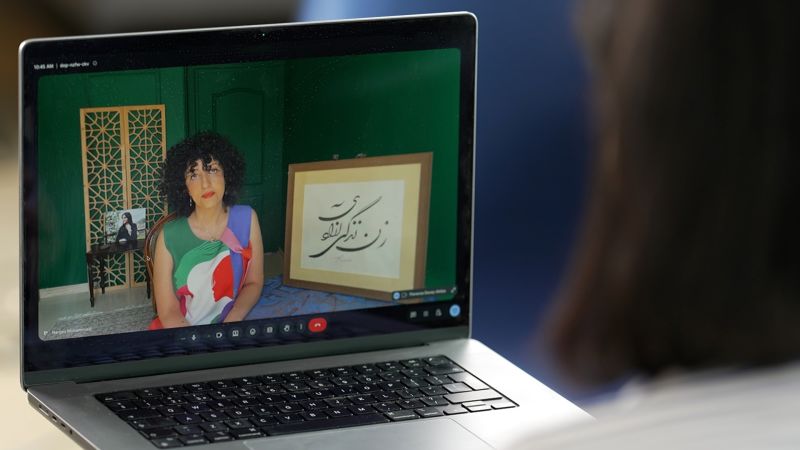
In her interview, Mohammadi wore a colorful dress featuring the word “peace” in several languages. Behind her was an image of Mahsa Jhina Amini, whose death after detention by Iran’s morality police prompted nationwide protests in autumn 2022.
The personal cost of resistance
Mohammadi has spent significant parts of the past two decades in prison because of her activism against Iran’s ruling system. Her foundation says she has received prison sentences totaling more than 44 years, as well as 154 lashes.
She said she would make the same decision to become an activist even if she had known the punishment that would follow. Yet she remains troubled by the effect of her imprisonment on her children, twins Ali and Kiana, who are now 19.
“But when I look at Ali and Kiana, I find myself filled with doubt. Did I really have the right to deprive them of a very ordinary life, of having their mother with them?”
Allegations of violence and medical neglect
Mohammadi’s most recent period in custody began in December and lasted until her medical release in May. In February, the Norwegian Nobel Committee cited credible reports that she had been beaten and subjected to treatment that endangered her life.
According to those accounts, she was struck with wooden sticks and batons during her December arrest, pulled by her hair and injured in the head. Jørgen Watne Frydnes, chair of the Norwegian Nobel Committee, said she was also repeatedly kicked in the pelvis and genital area, leaving her in severe pain and unable to sit or complete ordinary activities.
Mohammadi said she was then held in solitary confinement for two months while injured, without calls to her family or access to her lawyers. She later suffered what was believed to be a heart attack in March and lost 20 kilograms, or 44 pounds. Her foundation warned in April that she was in imminent danger.
She was hospitalized for 18 days, and her foundation said she had heart disease linked to prolonged anxiety and stress. Tasnim, a semi-official Iranian state news agency, rejected reports that her health had worsened. Mohammadi was later permitted to return home temporarily and says she continues to receive treatment.
Why Mohammadi continues to speak out
Nobel laureate Narges Mohammadi s memoir presents solitary confinement as more than separation from other prisoners. She argues that it is used to create lasting physical and psychological harm by undermining a detainee’s dignity, stability and sense of self.
Her decision to publish is rooted in a determination to preserve testimony from inside Iranian prisons. Even after losing notebooks, facing reported violence and enduring separation from her family, Mohammadi says documenting these experiences remains part of her wider struggle for human rights.
Frequently asked questions
What is Narges Mohammadi’s memoir about? A Woman Never Stops Fighting recounts her experiences as an Iranian human rights activist, including her allegations of abuse, solitary confinement and medical neglect in prison.
Why was Narges Mohammadi released from Evin prison? She was released in May on temporary medical leave after serious concerns about her health during detention.
When will the memoir be published? The book is due to be published this month in parts of Europe.