
US Navy Strikes Five Iranian Tankers as Middle East Conflict Escalates Sharply
Qwenews.com – A rapid-fire exchange of naval strikes and ballistic missile salvos pushed the American-Iranian confrontation to a new intensity on Tuesday, when Washington hit five Iranian oil carriers across two bodies of water and Tehran answered by raining missiles onto its regional ally Jordan. The two-day tit-for-tat sequence — which began with Iranian attempts to sink a US Navy warship and ended with a tanker burning and listing in the Gulf of Oman — marks the most dangerous escalation of hostilities since the broader war opened, and it signals that neither side is willing to step back from the waterways that carry roughly a fifth of the world’s traded crude.
Five Tankers Hit, One Sunk
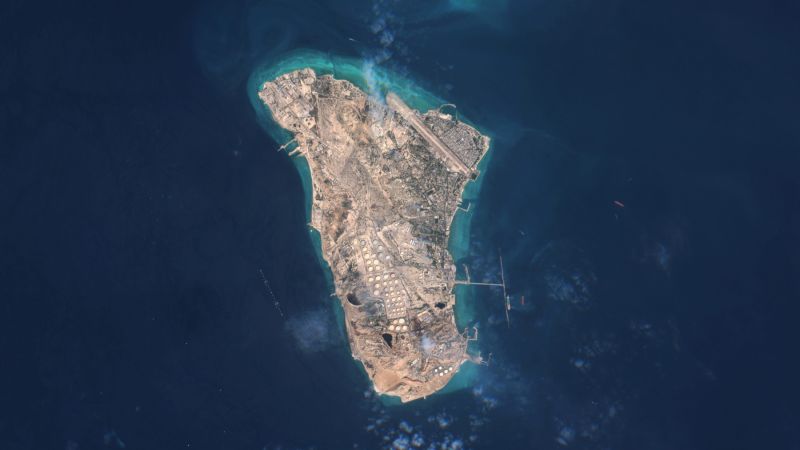
US Central Command confirmed that four crude oil carriers operating in the Gulf of Oman and a fifth vessel near Kharg Island in the Persian Gulf were struck on Tuesday. One of the targeted ships, identified as the M/T Riesco, was shown engulfed in flames and taking on water in footage released by the military to social media. CENTCOM stated that American forces ordered the crews of all five vessels to abandon ship before the weapons were released, and that no American personnel were injured in the operation.
Iran’s semi-official Tasnim News Agency placed one of the struck tankers roughly four nautical miles from Kharg Island, the Persian Gulf outcrop that serves as the primary loading hub for Iranian crude exports. State broadcaster IRIB reported that a second tanker was hit off the coast of Jask, near the mouth of the Gulf of Oman, and that crews from both vessels were being brought ashore in lifeboats.
Iran Fires Missile Barrage at Jordan
Tehran’s response came swiftly. Iran launched a salvo of ballistic missiles toward Jordan, declaring that its aim was Muwaffaq Salti Air Base, a facility long used by US forces for staging and logistics in the region. The Jordanian army announced that its air-defense network intercepted 20 incoming ballistic missiles, destroying 18 of them and allowing two to fall in unpopulated terrain. No fatalities were reported.
The choice of Jordan as a target is notable: it extends the geographic footprint of the conflict beyond the immediate Persian Gulf theater and tests the air-defense readiness of a country that has historically hosted American aviation assets. It also underscores how the war’s blast radius now reaches well beyond the two belligerents’ own coastlines.
Iran went further, issuing a direct threat against commercial shipping in the waters adjacent to its Gulf neighbors. State broadcaster IRIB quoted the Islamic Revolutionary Guard Corps as saying:
“We warn all crews aboard oil tankers in the vicinity of ports in Kuwait and Bahrain — which host these (American) terrorists and are partners in their hostile actions — to immediately leave their vessels, whether they are at anchor or docked at the ports, as the vessels will be targeted.”
Washington’s “Full Court Press” Strategy
The tanker strikes were not isolated incidents. They arrived the day after US forces hit three additional Iranian crude oil carriers over the weekend, following an IRGC attempt to attack a US aircraft carrier and a guided-missile destroyer. CENTCOM said the American ship evaded the ballistic missiles fired at it over the preceding two days and continued patrolling regional waters.
Together, these operations fit a pattern the Pentagon has described as a “full court press”: a coordinated effort to strike or disable targets around the Strait of Hormuz, escort commercial vessels through the narrow waterway, and maintain a naval blockade on Iranian ports. The stated objective is to ratchet up economic pressure on the regime’s leadership by choking the revenue streams that fund both the government and the IRGC’s military apparatus.
The Strait of Hormuz, at its narrowest roughly 33 nautical miles wide, carries an estimated 20 million barrels of oil per day — roughly one-fifth of global consumption. Disruption there sends immediate shockwaves through energy markets, shipping insurance premiums, and the economies of every Gulf state that depends on exporting hydrocarbons through the chokepoint. Kharg Island itself handles the bulk of Iran’s crude exports, making strikes near it a direct blow to Tehran’s fiscal lifeline.
Rubio Warns Tehran of Consequences
US Secretary of State Marco Rubio, speaking during a trip to Colombia, made the administration’s calculus explicit. Addressing reporters in Barranquilla, he said:
“Iran continues to try to hit US naval ships and for every time they do that, or try to do that, they’re going to lose tankers.”
The remark frames the tanker strikes not as punishment but as a standing exchange rate: each Iranian attempt against American naval assets will be answered by the destruction of equivalent Iranian maritime assets. It is a doctrine of proportional retaliation applied to the sea lane, and it raises the stakes for every commercial operator transiting the Gulf.
Airline Sanctions Tighten the Economic Grip
On the same day as the naval strikes, the Trump administration moved against Iran’s civil aviation sector. New sanctions swept in 27 Iranian airlines along with nine service providers and sales agents accused of facilitating operations for Mahan Air, a private carrier that has been under US sanctions since 2011. Mahan Air is widely regarded as a logistical arm of the IRGC, providing cargo and passenger transport that supports the corps’ regional operations. The airline measures complement the naval blockade by cutting another channel through which Tehran moves personnel, equipment, and revenue.
What Comes Next
The two-day exchange leaves both sides with damaged assets and heightened alert levels. Iran’s missile barrage at Jordan, while largely intercepted, demonstrated that Tehran can project firepower beyond the Gulf and into neighboring airspace. Washington’s repeated tanker strikes, meanwhile, signal that the blockade will persist and that Iranian maritime commerce remains a legitimate target set. With commercial shipping now explicitly threatened in the waters around Kuwait and Bahrain, the conflict’s economic consequences are spreading outward from the two belligerents to every nation whose economy depends on uninterrupted Gulf transit.
Related Reading
Frequently Asked Questions
What is Iran launches missile barrage at Jordan?
Iran launches missile barrage at Jordan is the main topic of this guide. The article explains the context, practical details, and next steps readers should understand.
Why does Iran launches missile barrage at Jordan matter?
Iran launches missile barrage at Jordan matters because readers are looking for a useful answer, not just a short summary. Good content should match search intent and help them decide what to do next.