
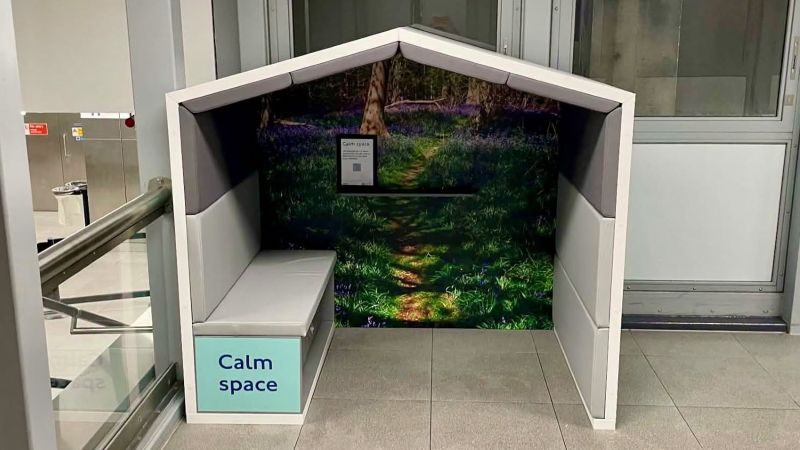
That’s a Dog Kennel: London’s Tube Calm Space
Qwenews.com – “That’s a dog kennel.” The verdict landed within minutes of Transport for London unveiling a small, roofed alcove at Ealing Broadway station, and it has stuck to the project ever since. The compact pod — bolted into the concourse of a busy west London interchange — was designed to give overwhelmed riders a moment of quiet amid the sensory assault of underground travel. Instead of quiet, it has drawn ridicule, confusion, and a heated debate over whether the structure’s shape, size, and placement actually help the people it was built for.
What the Pod Is and Who Built It
The unit is manufactured by NOOK, an American firm that produces modular shelter structures for public environments. At Ealing Broadway — a major interchange on the Piccadilly and District lines — the installation is an open-fronted frame with a roof but no door, no lock, and no meaningful enclosure. Transport for London, the city’s integrated transit authority, framed the trial as a pilot aimed at neurodivergent travellers, a group that includes more than one in every 100 residents of the United Kingdom who sit somewhere on the autism spectrum. Many autistic riders describe how screeching brakes, amplified PA announcements, packed platforms, and harsh fluorescent lighting can trigger acute distress, turning a routine commute into something physically unbearable.
TFL ran the trial in partnership with Autistica, a UK-based autism charity working across education, healthcare, and employment. In a statement released on Friday, the authority said the space is meant to
“support customers who may find travelling overwhelming and need a quiet space to pause, regulate and recover before continuing their journey.”
The trial was also promoted on TFL’s Facebook page, where the comments section quickly split between praise for the initiative’s goals and scepticism about its execution.
Public Reaction: From “Calm Space for Ants” to Design Criticism
While some commenters acknowledged the value of sensory relief in transit settings, a large share questioned whether an open-fronted alcove of modest dimensions could function as a genuine calming retreat. The most repeated comparison was blunt: “That’s a dog kennel.” Another user went further, writing that it “looks like a calm space for ants.” A third pointed to the pod’s position within the station layout:
“If it’s supposed to be a ‘calm’ place, then it’s at the wrong location at the top of the stairs to the platforms and near the lifts.”
That critique carries particular weight in a city where eating on the metro is an established habit. Ealing Broadway’s concourse is a continuous through-flow of commuters, food-delivery riders, and shoppers; situating a sensory refuge at the junction between escalators and platform stairs means the pod is ringed by constant foot traffic, conversation, and the mechanical rumble of trains arriving below.
Design criticism also came from riders with direct experience of sensory overwhelm. One commenter, identifying herself as autistic, flagged the absence of a door: “As someone who’s autistic, that needs a door. You’re literally exposed, it’s just a bench with a roof.” She added a suggestion about orientation, noting that facing the pod toward the main flow would make users feel “like animals in a zoo and gawped at.” Other comments ranged from the dismissive — calling the structure “basically a cupboard” — to the absurdist, with one user wondering whether it had been engineered for the diminutive hobbits of J.R.R. Tolkien’s fantasy novels. A separate commenter voiced a practical concern: “I could just picture teenagers in there vaping or a drunk person asleep!”
Timeline, Expansion, and What Comes Next
TFL confirmed the Ealing Broadway pod will remain in situ for a minimum of four weeks, after which the authority will assess usage data and rider feedback. A second installation is already scheduled: a calm space will be trialled at the London Transport Museum in Covent Garden for an eight-week period, giving the programme a longer observation window in a different architectural and foot-traffic context. TFL has not yet detailed what metrics will inform any design revisions or site relocations following the trials.
Autistica framed the trial within a broader campaign for what it calls “neuroinclusive” public infrastructure, arguing that transit authorities have a duty to accommodate sensory needs the same way they accommodate mobility needs. Whether the current pod design meets that standard remains, for now, an open question — one that commuters at Ealing Broadway have already answered with a chorus of “That’s a dog kennel” and a shrug.
FAQ: Practical Questions About the Calm Space Trial
Where is the calm space located? The pilot pod is installed in the concourse of Ealing Broadway station, a Piccadilly and District line interchange in west London. A second trial unit is scheduled for the London Transport Museum in Covent Garden.
Can anyone use the space, or is it restricted to autistic riders? The pod is open to all passengers. There is no door, lock, or admission requirement; riders simply step inside the open-fronted frame if they need a brief pause.
How long will the trial run? The Ealing Broadway installation will stay in place for at least four weeks. The Covent Garden trial is planned for eight weeks. TFL has not announced dates for any subsequent phases.
What happens after the trial ends? TFL said it will review usage data and rider feedback before deciding whether to revise the design, relocate the unit, or expand the programme. Specific metrics have not been published.
Why did so many people call it a dog kennel? The comparison — “That’s a dog kennel” — appeared repeatedly in social-media comments within hours of the launch. Commenters cited the pod’s small footprint, open front, and basic frame-and-roof construction as visually resembling a pet shelter rather than a dignified sensory refuge.