
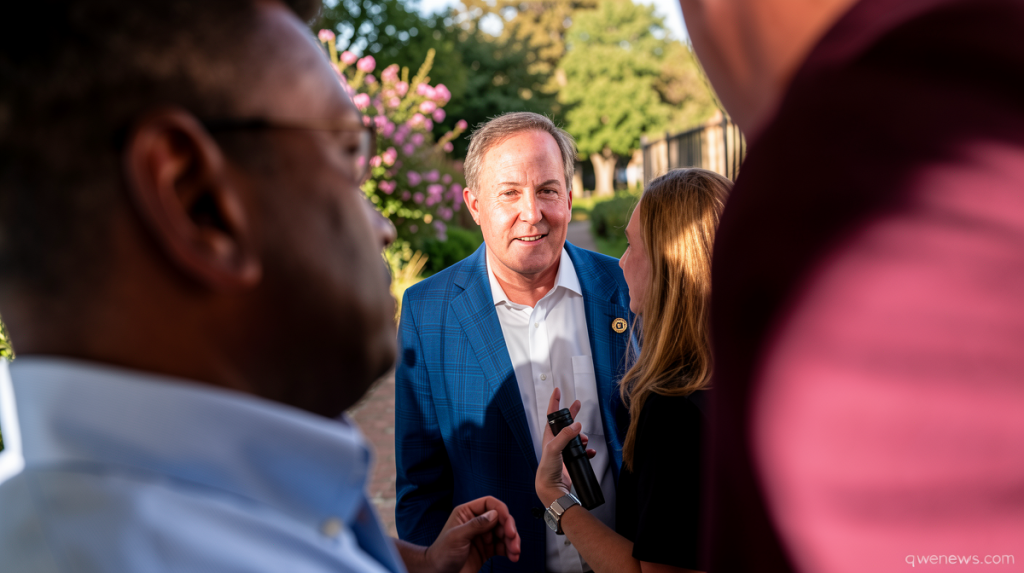
Texas Senate Race Becomes Flashpoint as GOP Leaders Clash Over Who Pays for Paxton’s Campaign
Qwenews.com – With roughly sixty days remaining before voters head to the polls, the contest between Texas Attorney General Ken Paxton and Democratic state Rep. James Talarico has evolved into something far more volatile than a simple down-ballot race. What began as a bruising primary runoff this spring — one of the most expensive and acrimonious Republican nominating fights in recent memory — has now metastasized into a full-blown intra-party confrontation over money, loyalty, and who ultimately bears responsibility for holding a pivotal red-state Senate seat.
The stakes could hardly be higher. Texas has not been genuinely competitive in a Senate race in decades, yet current polling suggests Talarico enjoys a meaningful image edge over Paxton, and the state is tracking closer than it has in generations. Should Democrats flip the seat, they would leapfrog dramatically toward a Senate majority. That arithmetic is precisely what has turned the race from a regional footnote into a national obsession inside the Republican caucus.
The Funding Standoff
At the heart of the current crisis is a simple question nobody wants to answer: who writes the check? Senate Republicans have conspicuously left Texas out of their coordinated ad-spending reservations, a move widely read as a deliberate pressure tactic aimed at forcing President Donald Trump’s political operation to shoulder the financial burden. The implicit message to the White House has grown increasingly blunt — you chose this candidate over an incumbent, now you own the outcome.
Trump’s operation, however, has not yet moved. For weeks, Paxton has been outgunned on television and digital advertising, while Talarico has poured significantly more money into the race. The gap has widened to the point where even allies inside the party are openly questioning whether the nominee can survive the final stretch without outside intervention.
Congressional Republicans Step Into the Ring
In recent days, a wave of senior congressional Republicans has moved from private frustration to public exhortation, telling Trump’s campaign apparatus directly that it must fund the Texas effort.
“We need help from the president,” Sen. John Kennedy of Louisiana told Fox News on Sunday. “The president says he has $850 million in his campaign accounts. That’s a lot of jack. I’m hoping that the president’s going to spend $100 or $200 million in Texas, but he hasn’t committed to it yet.”
Paxton himself, appearing on the same Fox News broadcast, answered two separate questions about the race by pointing to his financial shortfall rather than discussing policy or message. By Tuesday, Senate Majority Leader John Thune had joined the chorus on Fox, framing the contest as a must-win and insisting that allied resources must be deployed.
“I think all of our allies out there, including the president and his team and their resources, need to be brought to bear on Texas,” Thune said.
The pressure has not stopped at elected officials. Former George W. Bush strategist Karl Rove told the Texas Tribune that the outcome will “depend mightily” on whether Trump commits hundreds of millions of dollars to the midterm cycle. Rep. Troy Nehls of Texas told CNN’s Manu Raju on Tuesday that it “would be incumbent upon [Trump] to spend some money to try to help Ken Paxton.” Even Lara Trump, the president’s daughter-in-law, was pressed by a Fox News host on Wednesday about when her family’s groups might begin spending in the state.
Trump’s Mixed Signals
The president has offered verbal support without a corresponding financial commitment. Last week he declared, “I’m going to help Ken Paxton, and I’m going to spend a lot of time in Texas.” On Wednesday he went further, calling Paxton “the best attorney general in this country for the last 10 years or more,” while conceding that “some people don’t like the way he dresses, or some people don’t like the way he interviews or talks.”
What remains unclear is the shape of that support. Time in state is not money in the bank, and with two months of heavy advertising still ahead, the distinction matters enormously.
The Cornyn Aftermath
Compounding the funding anxiety is a second, uglier dynamic: lingering resentment over the runoff itself. Nehls has accused Sen. John Cornyn — the incumbent Paxton defeated with Trump’s explicit endorsement — of secretly hoping the nominee loses so he can validate his earlier warnings.
“He goes to bed, he’s thinking, ‘I need Ken Paxton to lose, because then I can look into the cameras and tell the voters of Texas, I told you, he wasn’t electable,'” Nehls said.
Cornyn has publicly affirmed support for the ticket but has continued to undercut the nominee. Last week he told CNN he would not campaign for Paxton. In remarks to the Texas Tribune, he went further, labeling the attorney general “a poor campaigner” who is “lazy and doesn’t raise money.”
“And he basically is not offering a very compelling case for his election,” Cornyn said. “He’s making this harder than it needs to be. But so be it — we are where we are.”
Conservative commentator Erick Erickson amplified similar criticisms on Tuesday, questioning Paxton’s character and accusing those urging Senate Republicans to spend in Texas of asking the party to sacrifice cheaper, more winnable races elsewhere. The episode drew a pointed response from Fox News host Laura Ingraham, underscoring how quickly a single state’s ballot question has become a proxy war over party discipline, presidential leverage, and the cost of choosing a candidate over an incumbent.
What emerges from the fog of these competing narratives is a party that cannot agree on its own nominee’s viability, cannot agree on who pays for the fight, and cannot agree on whether the president’s personal brand is sufficient collateral for a $200 million advertising war. In a state that has not been close in a Senate race since the early 1990s, that internal paralysis is itself the most dangerous variable in the equation.
Related Reading
Frequently Asked Questions
What is The GOP s game of chicken?
The GOP s game of chicken is the main topic of this guide. The article explains the context, practical details, and next steps readers should understand.
Why does The GOP s game of chicken matter?
The GOP s game of chicken matters because readers are looking for a useful answer, not just a short summary. Good content should match search intent and help them decide what to do next.