
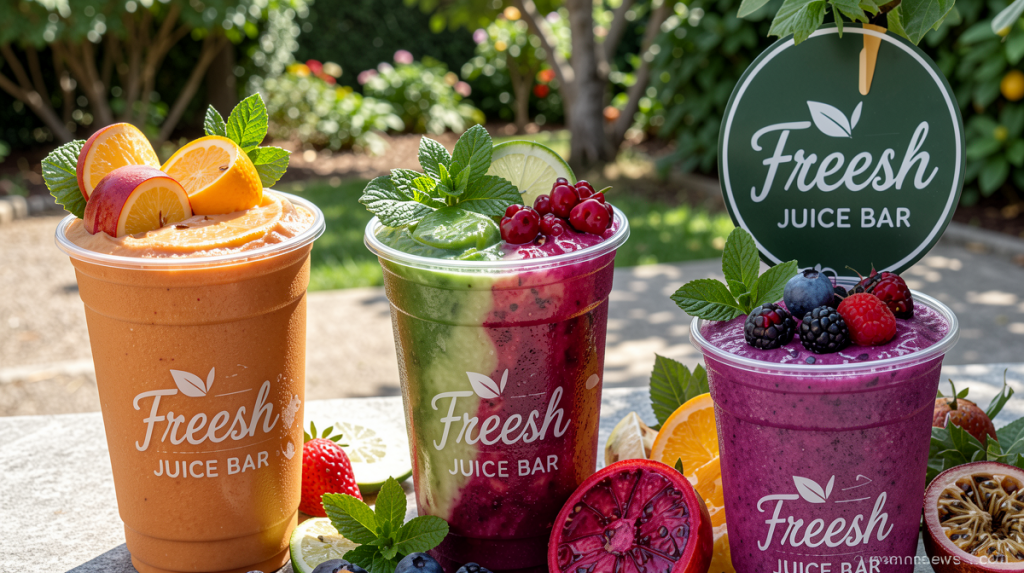
Why Appalling AI Menu Pictures Make Us Sick
Qwenews.com – Appalling AI menu pictures keep surfacing across street-food stalls and restaurant billboards, and the public reaction has shifted from mild curiosity to outright nausea. This summer, hyper-saturated, rubbery images of shrimp scampi, quiche, loaded fries, and spaghetti have set social media on fire. The backlash has crossed continents — from Hollywood night markets to Tokyo sandwich shops — and it has forced a sharper question into view: why does a slightly distorted image of dinner provoke such a visceral, almost physical revulsion?
How One Night-Market Walk Sparked the Backlash
In late August, Adaeze Onejeme, a 28-year-old advertising sales professional in Los Angeles, strolled through a Hollywood night market with her sister. Stall after stall displayed menus featuring taquitos, smoothies, and loaded fries. At first glance the photos looked real. A second look exposed an uncanny, synthetic sheen — textures too uniform, colors pushed past natural limits.
“I was like, ‘Those don’t look like chicken nuggets. Those don’t look like typical food that we eat,'” Onejeme recalled.
She dubbed the phenomenon an “AI flyer epidemic,” pulled out her phone, and recorded short clips of several stalls. Those clips landed on TikTok and spread rapidly. Rather than patronize a vendor whose menu relied on synthetic imagery, Onejeme chose a stand that still advertised its wares with straightforward, unembellished photographs.
“Not too long ago, people would just take a picture of the food and that would be on the menu. Now, these AI-generated pictures — the saturation, the coloring, the texture. It’s like you don’t even know what you’re going to get when it comes out,” she said. “At that point, is it false advertising?”
The Biology Behind the Disgust
Generative artificial intelligence has flooded marketing channels — product illustrations, promotional video, packaging art — and many consumers respond with discomfort or outright rejection. The dining context, however, appears to amplify the effect dramatically. Alexander Diel, a psychologist at Germany’s University of Duisburg-Essen, leads a research team examining how the public reacts to synthetic food imagery. His explanation centers on biology and culture intersecting.
“Food is important to us,” Diel said. “At the same time, it’s something that can easily make us sick, so we are very sensitive to when something is even slightly off.”
The revulsion is not merely aesthetic. Evolutionary psychology suggests humans evolved acute vigilance around anything that might signal contamination or spoilage. An image that looks almost right but not quite right activates that ancient alarm more reliably than a clearly stylized cartoon would. The slight deviation — a wrong curvature, a silicone-like gloss where starch should be — tips the viewer into repulsion.
A Global Gallery of Grotesques
The viral screenshots are not confined to American street food. In Tokyo, a sandwich advertisement depicts a bagel whose crumb structure resembles spun cobweb, filled with a tuna salad that appears to have been extruded through a pastry piping tip. In Kuala Lumpur, a bowl of spaghetti marinara resolves into what looks like neatly coiled yarn or strings of modeling clay. Berlin’s lunch scene has produced images of a quiche with small perforations in its crust and a plate of penne that reads as molded rubber.
Julia Damphouse, a 30-year-old tour guide in Berlin, captured the photograph of a restaurant billboard that went viral last month after she first spotted the image earlier in the summer.
“I see a lot of AI food and it just looks a bit shiny and strange, but there’s something particularly alien and wrong with this one,” Damphouse said. “There is something wrong with it. It looks too geometric. I imagine that’s it’s like if you take acid and food stops looking like food.”
The discomfort maps neatly onto a concept first articulated in 1970 by Japanese roboticist Masahiro Mori: the uncanny valley. Mori described the dip in comfort that occurs when a near-human figure — a robot, an animation, a synthetic image — is almost but not quite lifelike. Food imagery sits in the same valley. Sam Biddle, a technology journalist, photographed a deli menu in August featuring a “shrimp scampi” dish rendered as a cluster of circular, eyeless organisms. He later likened them to creatures from science fiction, underscoring how far some of these images stray from subtlety.
Frequently Asked Questions
Why do AI-generated food photos provoke stronger reactions than other synthetic images?
Food triggers a biological alarm system tied to contamination and spoilage. Even a minor textural or chromatic deviation in a dish image activates that vigilance more intensely than, say, a slightly off portrait or landscape, because the stakes of eating something spoiled are ancient and deeply encoded.
Are restaurants legally required to use real photographs on menus?
In most jurisdictions there is no specific law mandating photographic accuracy on printed menus, though consumer-protection and false-advertising statutes can apply if the image materially misrepresents the dish. Onejeme’s question — “is it false advertising?” — reflects a growing consumer expectation that menu imagery should be recognizable as the actual product.
How can diners tell whether a menu photo is AI-generated?
Look for textures that are too uniform, colors pushed past natural saturation, geometric or “molded” shapes in organic foods, and an overall glossy sheen inconsistent with real photography. When in doubt, ask the vendor for a photo of the actual dish before ordering.
Will restaurants stop using AI imagery after the backlash?
Some vendors have already reverted to straightforward photographs following viral criticism. Industry analysts suggest the backlash will pressure small operators to abandon synthetic imagery, while larger chains may continue experimenting with stylized illustrations that are clearly non-photographic and therefore avoid the uncanny-valley trigger.