
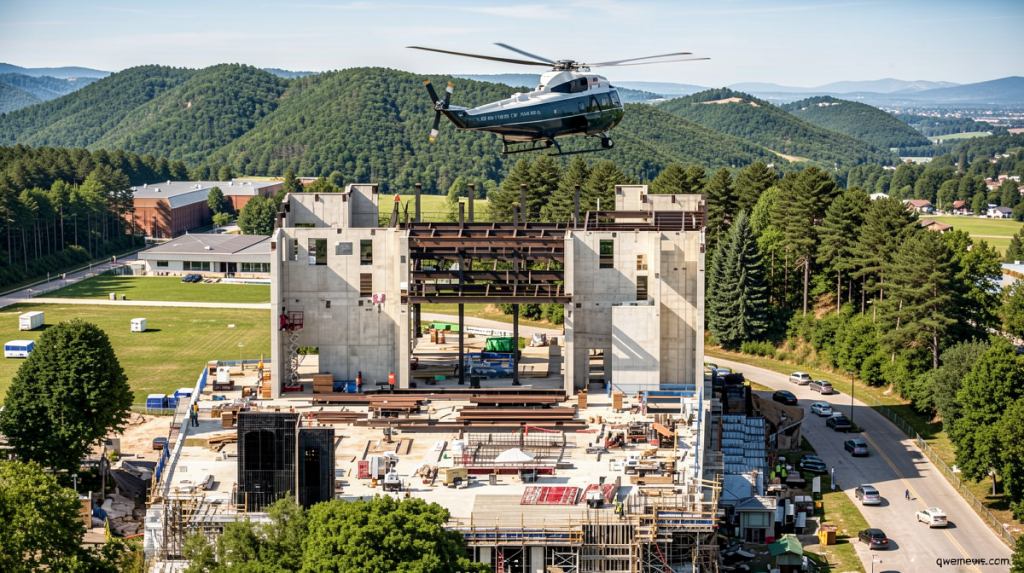
Construction Resumes: Supreme Court Sidesteps Ballroom Legality Question on Standing Grounds
Qwenews.com – Work on a nearly 90,000-square-foot ballroom annex to the White House will proceed, at least for now, after the Supreme Court issued a narrow ruling Monday that effectively removed the primary legal obstacle to the project. The justices voted 5-4 to conclude that the National Trust for Historic Preservation almost certainly lacks Article III standing to contest the construction, meaning the preservation group cannot use the courts to force an indefinite halt. Crucially, the court issued no determination on whether the ballroom itself complies with federal law.
The unsigned, eight-page opinion focused exclusively on procedural posture. The conservative majority held that the Trust’s claimed injury — rooted in the aesthetic and historical appreciation of one of its members — did not satisfy the constitutional requirement of a concrete, particularized harm sufficient to open the courthouse doors.
“We have repeatedly held that mere offense, disagreement, or distaste does not qualify as a concrete and particularized injury,” the majority wrote.
The opinion closed with an explicit reservation of the merits question:
“Today, we do not pass upon the legality of the government’s East Wing project. We conclude only that, based on the submissions before us, the government is likely to prevail in showing that the Trust lacks Article III standing to challenge the project.”
A Dissent That Read Like a History Lesson
Chief Justice John Roberts, joined by the court’s three liberal justices, filed a dissent that departed sharply from the usual brevity of split opinions. Roberts described the construction as “likely unlawful” and framed the dispute in terms of separation of powers rather than mere aesthetics.
“The White House is not just any building,” Roberts wrote. “In failing to appreciate as much, the court misconceives the plaintiff’s injury, allowing the executive’s likely infringement of the legislature’s power of the purse and authority to regulate federal property in the District of Columbia to continue.”
The chief justice invoked Winston Churchill’s famous observation that people “shape our buildings, and afterwards our buildings shape us,” then turned the aphorism into a call for institutional discipline:
“[That] is all the more reason to ensure that those responsible follow the rules in deciding what to tear down and what to build up at the People’s House.”
Trump Hails the Ruling as Final
President Donald Trump took to social media Monday evening to declare the matter closed. He described himself as “pleased” and characterized the legal challenge as fully resolved.
“I am pleased to report that the United States Supreme Court has just ruled in favor of the Ballroom/Military Complex being built without any further contingency, doubt, or threat,” he posted.
Trump labeled the preservation group’s lawsuit “baseless” and pledged that the completed structure would be “one of the Greatest ever constructed in Washington, D.C.” He has long framed the ballroom as the architectural centerpiece of his presidential legacy, arguing that its state-of-the-art defensive features make it a national-security necessity rather than a vanity project.
The Lower-Court Path That Got Here
The Supreme Court’s intervention came after the U.S. Court of Appeals for the District of Columbia had ruled 2-1 against the administration earlier this month. That panel held that the decision to demolish the East Wing and erect a gilded ballroom site without congressional authorization exceeded executive authority.
“Whether or not a massive ballroom should be constructed is for Congress to decide and is not a matter for Executive self-help,” the D.C. Circuit wrote.
The National Trust for Historic Preservation had argued it possessed standing because member Alison Hoagland, an architectural historian, demonstrated that her personal enjoyment of the White House as a landmark was being concretely impaired by the demolition and reconstruction. The Supreme Court majority found that showing insufficient.
Pattern on the Emergency Docket
The ballroom decision is the latest in a string of favorable emergency-docket outcomes for the administration. Critics of the court’s practice — often called the “shadow docket” — note that the president helped assemble the current conservative supermajority during his first term by appointing three justices, and that the expedited writ process now allows the executive to obtain rapid, often unreviewed reversals of lower-court orders touching immigration enforcement, agency structure, and other contested initiatives.
For the ballroom specifically, the practical effect of Monday’s ruling is to buy the administration time. Litigation over the project’s substantive legality will continue in lower courts, but the immediate threat of a nationwide injunction has been lifted. Construction crews can resume work on what the White House describes as a combined ceremonial and military-complex facility, while Congress — which Roberts’s dissent identified as the proper arbiter of the question — remains silent.
Broader Implications for Federal Property and Presidential Taste
The White House has long been treated as a federal asset subject to congressional appropriations and District of Columbia land-use rules, not as a personal estate of the occupant. Trump has nonetheless pressed a hands-on role in multiple capital-area projects beyond the ballroom, including a triumphal arch, alterations to the Lincoln Memorial reflecting pool, and a planned renovation of the Kennedy Center. Each has drawn its own legal challenge.
By resolving the ballroom dispute on standing grounds rather than on the merits, the Supreme Court left intact the question of whether a president may unilaterally authorize the demolition of a historic federal wing and the expenditure of public funds on a new structure without legislative approval. That question, Roberts’s dissent suggests, may yet return to the court in a different procedural posture — or may simply be answered by the passage of time as the ballroom rises above the East Wing site.
Related Reading
Frequently Asked Questions
What is Supreme Court allows Trump to continue?
Supreme Court allows Trump to continue is the main topic of this guide. The article explains the context, practical details, and next steps readers should understand.
Why does Supreme Court allows Trump to continue matter?
Supreme Court allows Trump to continue matters because readers are looking for a useful answer, not just a short summary. Good content should match search intent and help them decide what to do next.