
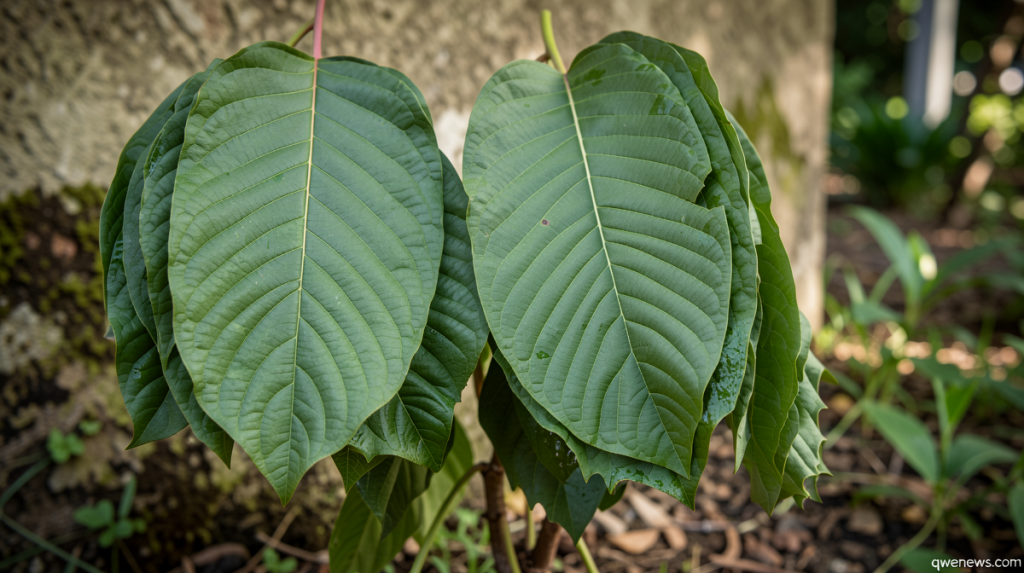
DEA Makes Kratom Compounds Schedule I
Qwenews.com – The Drug Enforcement Administration has moved to place three semisynthetic kratom derivatives under Schedule I control on an emergency basis. DEA makes kratom related compounds subject to the strictest federal drug classification — the same tier reserved for heroin, LSD, and cannabis — effective August 25. The designation carries a two-year sunset, after which it expires unless converted to permanent status through standard rulemaking.
The compounds at issue already appear in powders, chewable tablets, and liquid shots sold at gas stations, smoke shops, and convenience stores nationwide. Two of the three substances have been confirmed in consumer products; the third, MGM-16, has not yet been verified on shelves, though regulators acted preemptively on the expectation it would fill the gap left by its chemical siblings.
Chemistry Behind the Designation
Kratom derives from Mitragyna speciosa, a tropical tree native to Southeast Asia whose leaves contain more than 40 naturally occurring alkaloids. Mitragynine is the most abundant psychoactive alkaloid in the leaf. During metabolism or drying, mitragynine converts into 7-hydroxymitragynine (7-OH), which typically represents only 1–2% of total alkaloid content in natural leaf products.
The three newly scheduled substances are laboratory-engineered derivatives of 7-OH rather than natural plant constituents. Mitragynine pseudoindoxyl (MGPI) is a high-potency, chemically rearranged version of 7-OH. MGM-15 and MGM-16 are additional semisynthetic derivatives of the same parent compound. Many products marketed as “semisynthetic 7-OH” also contain MGPI or MGM-15, though not universally.
Regulatory Rationale and Political Context
US Attorney General Todd Blanche framed the action as preventive. In the announcement he stated:
“The Justice Department is acting before these dangerous compounds become a broader threat. The substances are being manufactured and sold in consumer products, often under labels that obscure their true risks. This action will protect our nation’s children and communities from the dangers of drug addiction and abuse.”
The DOJ cited animal research demonstrating opioid-like pharmacological effects for all three compounds. Separately, the Department of Health and Human Services extended the public-comment window on a proposed numerical threshold for 7-OH scheduling under the Controlled Substances Act until September 10. The alarm bells had been sounding earlier: in July 2025, HHS recommended Schedule I classification for concentrated semisynthetic 7-OH without accompanying data, a step that drew criticism from industry groups and some clinicians who argued the evidence base was insufficient at that stage.
By placing these substances under emergency control, the DEA makes kratom related compounds unavailable for commercial distribution or new research until the sunset period concludes or permanent scheduling is finalized.
Clinicians Report a Surge in Dependence Cases
On the ground, addiction specialists describe a sharp acceleration in the problem. Dr. Myles Jen Kin, board-certified in both addiction medicine and emergency medicine and serving as medical director at the Recovery Centers of America’s Massachusetts location, reported a tenfold jump in weekly caseload over roughly twelve months:
“A year ago, I might see maybe one a week, and now we’re probably seeing 10 cases a week. I think this is a necessary regulation that needs to happen.”
Dr. Caleb Banta-Green, a research professor of psychiatry and behavioral sciences at the University of Washington School of Medicine, raised a different concern: what happens to people already dependent on these products once they can no longer purchase them. Some individuals with opioid use disorder turn to natural or semisynthetic kratom-related compounds as perceived lower-harm alternatives or as tools for managing withdrawal after quitting opioids, Banta-Green noted. Jen Kin urged affected consumers not to attempt abrupt cessation without medical supervision:
“If you stop taking any of these chemicals and you are feeling sick, immediately seek care at the closest addiction medicine or treatment center in the area. If you’re having a life-threatening crisis, then obviously you should go to the hospital.”
Frequently Asked Questions
Does this scheduling affect natural kratom leaf products? No. The emergency designation targets three specific semisynthetic derivatives of 7-OH (MGPI, MGM-15, and MGM-16). Whole-leaf kratom and standard extracts are not covered by this action, though a separate HHS proposal addressing a numerical 7-OH threshold remains in public comment through September 10.
What happens after the two-year sunset expires? Unless the standard rulemaking process converts the emergency scheduling into permanent status, the Schedule I designation lapses and the compounds return to their prior regulatory posture. Industry and advocacy groups can petition during the interim period.
Where should consumers go if they feel withdrawal symptoms after stopping a 7-OH product? Addiction-medicine clinics and treatment centers are the first point of contact. In a life-threatening crisis, go directly to the nearest hospital emergency department, per the guidance issued by clinicians cited in the announcement.