
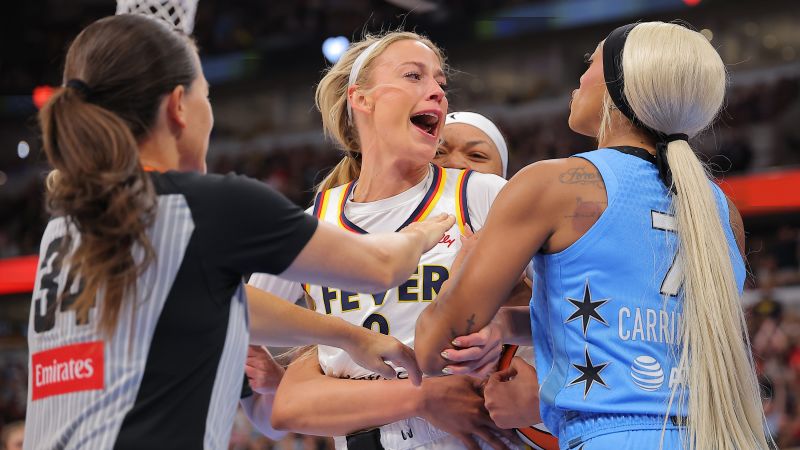
WNBA at a Crossroads: Lessons from the NBA’s Darkest Hour
Qwenews.com – What one of the NBA s most defining crises can teach the WNBA after a turbulent summer of off-court drama and internal conflict. The women’s professional basketball league stands at a pivotal moment, echoing a transformative period in its male counterpart’s history. While often dismissed as entertainment over athletics, the WNBA needs leadership as decisive as what David Stern brought during the NBA’s darkest era. That turning point came on November 19, 2004, when Detroit Pistons center Ben Wallace attempted a layup and collided with Indiana Pacers forward Ron Artest. What started as a minor shove exploded into a full-scale brawl between rosters.
How the NBA Turned Around
Had the confrontation ended on the court, the incident might have been dismissed as another sports brawl. However, the league faced compounding challenges. The legendary trio of Michael Jordan, Magic Johnson, and Larry Bird had retired, leaving a vacuum that no single player filled. Instead of maintaining the game’s elegance, basketball devolved into something resembling street combat, with referees struggling to control the escalating physicality.
The disconnect between athletes and their audience grew increasingly apparent. According to one league official speaking with the Washington Post, a focus group evaluation placed NBA players as the least beloved athletes across all professional sports. This context set the stage for events that unfolded in Auburn Hills, Michigan.
As tensions between the two teams gradually subsided, a spectator hurled a beverage at Artest while he rested on the scorer’s table. Enraged, Artest ascended into the crowd to confront the culprit. Stephen Jackson trailed behind him, and within moments, players and spectators exchanged punches, generating scenes of pandemonium that would linger in collective memory.
The aftermath proved devastating for viewership. NBA Finals ratings plummeted by 29 percent. Commissioner Stern responded with decisive action, imposing suspensions totaling 141 games across nine participants, with Artest absorbing 86 of those days. Yet Stern’s vision extended beyond punishment.
During negotiations that summer, he secured agreement from the National Basketball Players Association for two additional mandatory community service appearances each season. He also required players to sign autographs upon leaving the court after warmups. Furthermore, Stern launched the NBA Cares program, targeting $100 million in charitable contributions over five years. A dress code followed, establishing business casual standards while prohibiting head coverings, chains, and medals worn over garments.
Many athletes resented these changes, viewing them as criticism of Black culture. As Allen Iverson famously remarked, “Just because you put a guy in a tuxedo doesn’t mean he’s a good guy.” Nevertheless, Stern discovered allies in unexpected quarters.
“Let’s be honest: image is everything. And they’re trying to change the image of the league. Between the fight in Detroit last year and other perceptions, they’ve realized they have a public relations issue. They’ve set out to change it.”
Spike Lee’s words captured the sentiment of those who recognized the necessity of transformation.
The WNBA’s Parallel Challenge
Two decades later, the women’s league confronts an analogous situation. Despite possessing extraordinary talent, broad appeal, and quality basketball, the WNBA risks becoming a caricature of itself. Casual observers may overlook A’ja Wilson’s brilliance while enthusiastically sharing memes about Sophie Cunningham. Political commentators eagerly debate transgender participation in a league where no athlete has publicly identified as transgender.
Meanwhile, remarkable performances go unnoticed. Kayla McBride recently connected on ten three-pointers for the Minnesota Lynx while scoring 43 points. Yet Celeste Keaton, owner of the Seattle Storm, faced scrutiny for publicly reprimanding children. The constant noise resembles theatrical melodrama, exhausting for everyone involved.
Indiana Fever head coach Stephanie White has voiced her concerns directly, criticizing “divisiveness that’s trying to hijack our league.” Such internal conflict represents both an injustice to pioneering players and a genuine threat to organizational stability.
Neither players nor management bear sole responsibility. This situation reflects broader societal patterns. Personal conflicts receive different treatment depending on gender—acceptable in men’s athletics but labeled as “catfights” in women’s sports, where harmony remains expected. The WNBA’s challenges extend beyond basketball, revealing that cultural progress has not advanced as rapidly as many believe.
Frequently Asked Questions
What happened in the NBA brawl of 2004? On November 19, 2004, Ben Wallace and Ron Artest collided during a game, sparking a massive fight involving players and fans in Auburn Hills, Michigan.
How did the NBA respond to the crisis? Commissioner David Stern imposed 141 total game suspensions, introduced a dress code, launched NBA Cares with $100 million in charitable goals, and mandated community service appearances.
What is the WNBA currently facing? The league is dealing with off-court drama, political debates, and internal divisiveness that threaten to overshadow on-court excellence.
Why is this moment significant for the WNBA? Like the NBA in 2004, the WNBA has the opportunity to address its image challenges while building on its growing talent and fan base.