
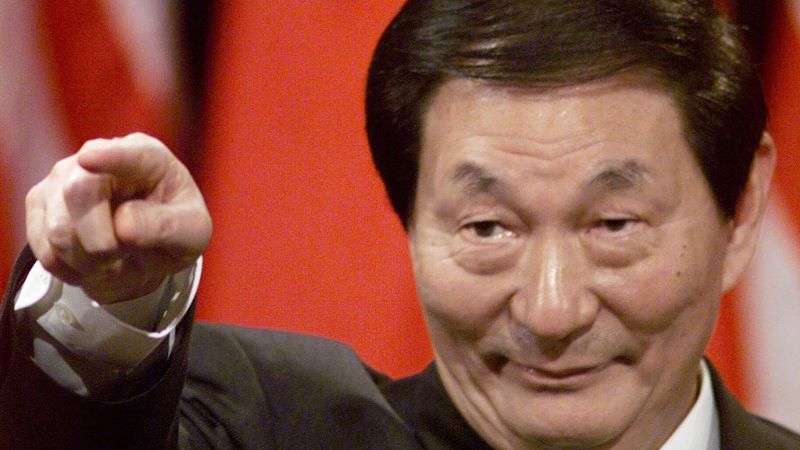
Zhu Rongji, Architect of China’s Economic Transformation, Passes Away at 97
Qwenews.com – The steely statesman who served as China’s premier during a pivotal period has died following an illness. According to Xinhua, the state news agency, Zhu Rongji passed away on Wednesday morning in Beijing at the age of 97. He leaves behind his wife and their two children.
Often referred to as the nation’s “economic czar,” Zhu guided China through a fundamental shift from a centrally planned system toward a market-oriented economy. His tenure as premier spanned from 1998 until 2003, though his influence on economic policy extended well beyond those years, beginning in the early 1990s when he first served as vice premier under Jiang Zemin, who passed away in late 2022.
A Visionary Leader’s Legacy
For many Chinese citizens who experienced the country’s dramatic transformation, Zhu’s passing signals the close of an era defined by economic optimism. The sweeping reforms he championed produced remarkable outcomes: a dramatic decline in poverty levels, the emergence of a vast middle class, and intense competition among international corporations seeking entry into China’s lucrative domestic market.
Today, the world’s second-largest economy shows signs of slowing after decades of extraordinary expansion. This growth trajectory was largely driven by leaders such as Zhu, who implemented Deng Xiaoping’s ambitious “reform and opening” strategy with unwavering determination.
The Communist Party’s official tribute emphasized Zhu’s contribution during what it described as a “crucial stage” of transition from a planned economy to a socialist market system. The statement also highlighted his “deep affection” for ordinary citizens.
“He emphasized that government officials must always bear in mind that they are public servants; they should have the courage to speak the truth without fear of offending others, (and) eschew special privileges … while making every effort to deliver tangible results for the people,”
Reforms and Challenges
As a determined technocrat, Zhu implemented numerous difficult but essential changes. These included comprehensive revisions to fiscal and taxation structures alongside a major restructuring of the oversized state sector. His aggressive approach to reform frequently generated controversy.
One particularly contentious initiative involved streamlining inefficient state-owned enterprises, which resulted in approximately 40 million workers losing their positions. His efforts to secure China’s membership in the World Trade Organization also faced criticism from officials who argued he made excessive concessions—some even claimed he was compromising national interests.
History ultimately vindicated his position. Analysts consider WTO accession a watershed moment that integrated China into global commerce, attracting substantial foreign investment and trade that propelled unprecedented economic expansion in subsequent years.
Internationally, Zhu remains best remembered for his leadership in securing China’s entry into the World Trade Organization in 2001. This achievement opened pathways for double-digit growth rates that cemented the nation’s status as a dominant global power.
Personal Character and Political Journey
Zhu’s uncompromising style, pragmatic decision-making, and resolute opposition to corruption earned him both devoted supporters and vocal adversaries within the party. His sharp wit, quick temper, and candid manner resonated with a public accustomed to carefully scripted official pronouncements. This combination of traits secured him the moniker “the iron-fisted premier.”
His determination was evident in a memorable statement delivered at a 1998 press conference following his appointment as premier, the country’s second-highest position:
“No matter whether there is a minefield or an abyss ahead of me, I will move forward without hesitation, and I will do my best until I die,”
Early Life and Career Path
Originally from Hunan province in southern China, Zhu earned an electrical engineering degree from Tsinghua University, one of the nation’s most prestigious academic institutions. He subsequently began his career at a state planning agency.
Like many of his contemporaries, Zhu’s early professional trajectory was disrupted by the political turbulence of the Mao Zedong period. He was expelled from the Communist Party during the late 1950s after voicing criticism of government economic strategies, and faced another purge during the Cultural Revolution ten years later.
Following Mao’s death, Zhu underwent political rehabilitation and was permitted to rejoin the party. He steadily advanced through various economic positions, eventually becoming Shanghai’s mayor in 1988. His performance in that role attracted the attention of Deng Xiaoping.
In 1991, Zhu was selected to oversee national economic management as vice premier, and seven years later received promotion to premier. During his early leadership years, he successfully curbed rampant inflation, modernized the currency framework, and navigated the Chinese economy through Asia’s financial crisis in 1997.
In the introduction to a collection of Zhu’s writings and addresses, the late American Secretary of State Henry Kissinger praised the former premier as “a penetrating mind” who “grappled with one of the most sign”
Related Reading
Frequently Asked Questions
What is Zhu Rongji the economic czar who helped?
Zhu Rongji the economic czar who helped is the main topic of this guide. The article explains the context, practical details, and next steps readers should understand.
Why does Zhu Rongji the economic czar who helped matter?
Zhu Rongji the economic czar who helped matters because readers are looking for a useful answer, not just a short summary. Good content should match search intent and help them decide what to do next.