
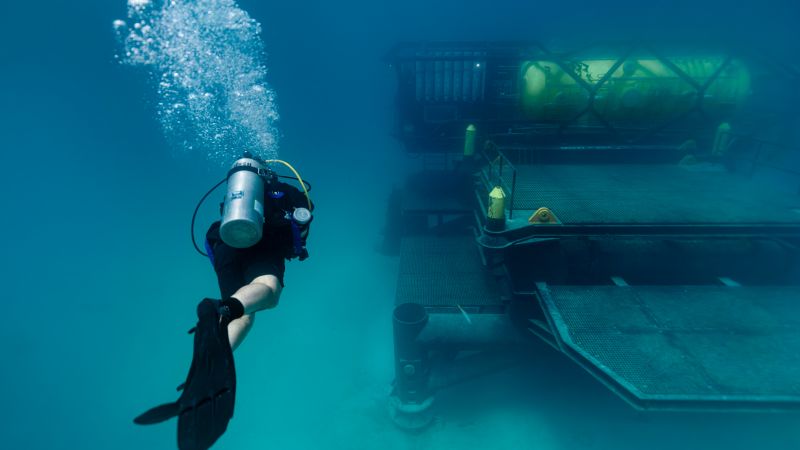
The First New Underwater Habitat Sparks a Race to the Bottom
Qwenews.com – The first new underwater habitat in decades has arrived in the Florida Keys, potentially igniting renewed interest in subsea exploration. For decades, the ocean’s depths remained largely unexplored by human residents, but that era is ending. The Aquarius Reef Base, positioned off Florida’s coastline, once relied on an underwater outhouse where crew members would swim for privacy. Local marine life quickly learned the routine. “Fish, unfortunately, would know why you were out there and they would swarm,” remembered Dawn Kernagis during her 2016 NASA mission aboard Aquarius. Fellow resident Garrett Reisman likened the phenomenon to “like the dinner bell going off.” Today, Aquarius features two onboard toilets and has abandoned the outhouse entirely.
Vanguard: A Historic Return to Subsea Habitation
After a forty-year absence, the United States now hosts another underwater habitat. DEEP, the organization responsible for Vanguard, has positioned its new habitat on Tennessee Reef’s seafloor within the Florida Keys National Marine Sanctuary. Located fifty-six feet beneath the waves, this deployment marks the first subsea human habitat in American waters since the 1980s. For researchers who depended exclusively on Aquarius as the world’s sole operational underwater laboratory, this development carries considerable significance.
Underwater habitation traces its origins to the 1960s, when Jacques-Yves Cousteau’s Conshelf project initiated an era of deep-sea exploration. Similar stations emerged across the United States, Europe, Russia, and Japan, driven by ambitions parallel to the space race above. However, most facilities proved cramped, austere, and expensive, resulting in brief operational periods before the movement gradually declined. The International Space Station’s announcement, assembly, and continuous occupation over twenty-five years occurred during the gap between Aquarius’s deployment and Vanguard’s arrival.
Design and Scientific Mission
Vanguard measures thirty-five feet in length and eight feet in width, providing adequate living quarters for four aquanauts during five or seven-day missions. Aquarius, by comparison, offers slightly more space and accommodates six crew members for extended stays exceeding thirty days. The new station connects to the surface through a buoy that supplies fresh air while incorporating modern technology to minimize environmental footprint.
Waste management represents a key innovation. The habitat captures both gray water and human waste in external tanks before pumping everything upward to the support buoy for processing. This system supports Vanguard’s primary scientific objective: monitoring and potentially restoring a coral garden facing ecological challenges. DEEP’s director of scientific research, Kernagis, described the location—four point six nautical miles south of Long Key—as “a really solid area for reef restoration.”
Advantages of Saturation Diving
The reef region, celebrated for its deepwater corals and sponges, has suffered from rising temperatures and coral bleaching. When corals experience stress, they lose their algae coating, depriving them of nutrition and causing them to turn pale. Vanguard’s research team will work to identify resilient coral species and replace damaged specimens.
Becoming “part of the reef” offers numerous advantages, according to Kernagis. Aquanauts can navigate their environment using traditional scuba equipment or oxygen-fed helmets connected by umbilical cords extending several hundred feet. Saturation diving enables scientists to remain at the same pressure as their dive site, facilitating extended underwater periods. “You can get a month’s worth of work done in less than a week,” Kernagis noted, contrasting this approach with conventional diving that requires decompression and faces oxygen limitations. Analyzing samples directly at depth rather than transporting them to the surface yields superior data, since time delays and decompression processes can modify materials before analysis.
“The first new underwater habitat in decades represents more than just technological advancement—it’s a gateway to understanding our oceans like never before.” — DEEP Organization
Frequently Asked Questions
How deep is the new underwater habitat? Vanguard sits at fifty-six feet below the ocean surface on Tennessee Reef in the Florida Keys.
How many people can live in the habitat? The new underwater habitat accommodates four aquanauts for missions lasting five to seven days.
What is the main scientific purpose? Researchers will monitor and restore coral gardens facing ecological challenges from rising temperatures and bleaching.
How does waste disposal work? Both gray water and human waste are captured in external tanks and pumped to the surface buoy for processing.
Why is saturation diving important? It allows scientists to stay at constant pressure, enabling extended underwater work without repeated decompression stops.