
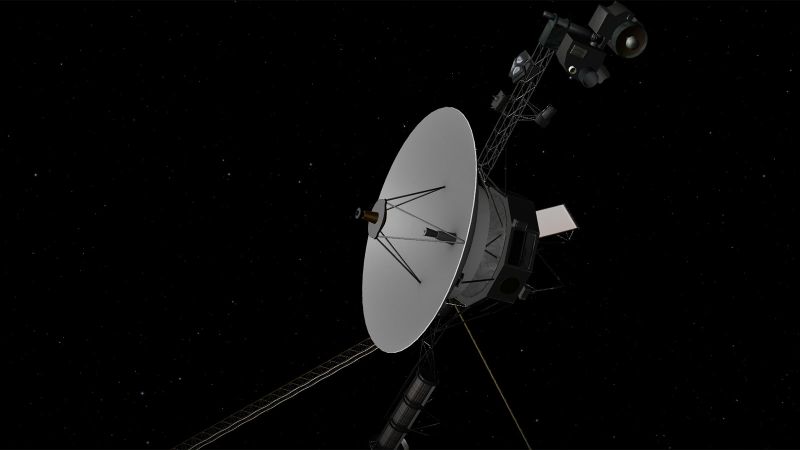
Big Bang Fix Could Be Buying More Time for Voyager 2
Qwenews.com – An ambitious effort to extend an aging probe’s journey through interstellar space has achieved remarkable success. NASA engineers at the Jet Propulsion Laboratory in Pasadena, California, have implemented what they call the Big Bang fix could be buying the historic Voyager 2 spacecraft additional years of scientific operations. Currently positioned approximately 21.35 billion kilometers (13 billion miles) from Earth, Voyager 2 joins its twin Voyager 1, which sits about 25.40 billion kilometers (16 billion miles) away.
Extending the Mission Beyond Expectations
Both spacecraft launched just weeks apart in 1977, embarking on revolutionary planetary flybys that transformed our understanding of the outer solar system. Now traveling beyond the heliosphere—the sun’s protective bubble of magnetic fields and particles that extends well past Pluto’s orbit—these probes continue operating far beyond their original five-year design lifespan.
“Each of us love these spacecraft, and give generously of our time off-hours and weekends, so the feeling of realizing that we had extended the life of the spacecraft and science return by 2 years or more was fulfillment and delight.”
The probes rely on radioisotope thermoelectric generators, devices that convert heat from decaying plutonium into electricity. However, they lose approximately 4 watts of power annually, forcing engineers to systematically shut down instruments and systems. Voyager 2 was originally scheduled to power down another science instrument before year-end, but the new approach changed that trajectory.
The solution involved a simultaneous command sequence that turned off certain powered devices while activating others with lower power requirements. This careful balancing act maintains sufficient warmth for operations while preserving scientific capabilities. According to NASA, Voyager 2 now possesses enough power to operate its three remaining instruments for an additional year.
Testing and Implementation Process
The Big Bang fix was executed on July 9, involving the shutdown of two dedicated heaters and a digital tape recorder that primarily provided residual heat. In exchange, two different heaters and another heat-supplying device were activated, though these consume less power than their predecessors.
Engineers conducted extensive testing throughout May and June to verify that the modification wouldn’t exceed power expectations or drop temperatures beyond acceptable thresholds. Communication delays are significant—nearly 20 hours for commands to reach Voyager 2, followed by an equally lengthy wait for responses.
“We had done so much work over the last year and I was very close to the analysis and our predictions, so seeing the first test results be so close to our expectations gave me confidence and excitement and, well, joy,” said mission manager Kareem Badaruddin.
Following successful verification, engineers updated Voyager 2’s onboard software. Should the spacecraft enter safe mode due to detected anomalies, the lower-powered devices will now be included in the default safe state configuration.
Looking Ahead: Voyager 1’s Turn
The team has already completed a successful power test on Voyager 1 at the end of July. With the spacecraft positioned even farther from Earth, signals require nearly 24 hours to complete a round trip. The next phase involves a thermal test scheduled for late August, contingent on data analysis results.
Conserving power on Voyager 1 could accomplish more than mere extension—it might enable the team to reactivate the Low-energy Charged Particles experiment, an instrument that had been dormant for decades. If fuel lines freeze, both spacecraft would lose their ability to maintain antenna orientation toward Earth, potentially ending these historic missions permanently.
Frequently Asked Questions
What is the Big Bang fix? The Big Bang fix is a power management strategy that swaps high-consumption devices for lower-power alternatives while maintaining thermal stability for Voyager 2’s continued operations.
How much additional time does the fix provide? The modification extends Voyager 2’s operational life by approximately 2 years or more, allowing its three remaining instruments to continue collecting scientific data.
Why is timing critical for these spacecraft? In the frigid temperatures of interstellar space, frozen fuel lines would prevent the spacecraft from pointing their antennas toward Earth, resulting in permanent loss of communication.
When will Voyager 1 receive the same treatment? Voyager 1’s thermal test is scheduled for the end of August, with the full implementation following successful verification of temperature stability.