
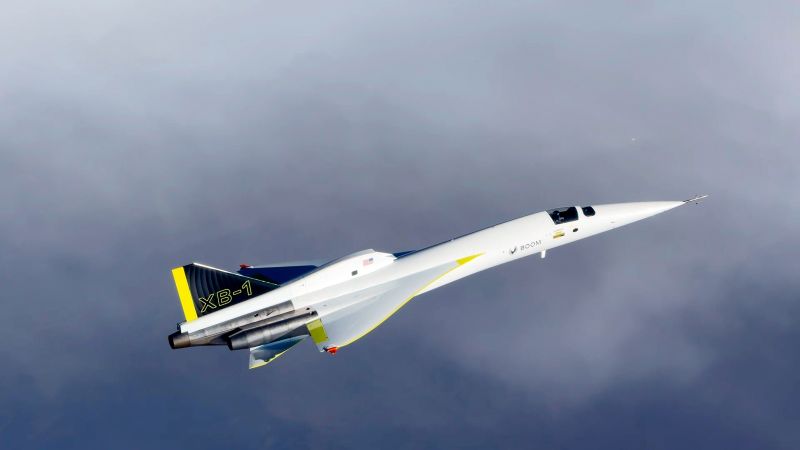
A New Dawn for Supersonic Aviation: The Sonic Boom Challenge
Qwenews.com – Half a century after the FAA effectively halted civilian supersonic travel across American skies, a transformative shift appears imminent. In June, the Federal Aviation Administration unveiled reimagined regulations designed to usher in a fresh era of faster-than-sound passenger flights. Rather than relying on speed thresholds, the proposed framework adopts a noise-based metric, simultaneously repealing the 1973 prohibition that grounded supersonic journeys over land. Agency officials target mid-2027 for finalizing these updated standards.
“It’s a long time in coming,” noted Juan Alonso, a professor within Stanford University’s aeronautics and astronautics department in California. “I think it’s a welcome legislation, and I would say NASA and the US industry have been pushing in this direction for a very long time.”
Historical Roots of the Sonic Boom Ban
The path to this regulatory evolution traces back to 1964, when Oklahoma City experienced six months of deliberate aerial thunder. Military aircraft conducted a controversial test, unleashing 1,253 sonic booms upon the population below in a daily barrage. The Federal Aviation Administration orchestrated this campaign to measure public sentiment regarding supersonic aviation. These flights, traveling faster than sound, promised the possibility of halving travel times.
Despite the potential, the Oklahoma City experiment proved pivotal. Congress withdrew funding in 1971 for Boeing’s ambitious 2707 supersonic aircraft, narrowing the commercial supersonic competition to Europe’s Concorde and the Soviet Union’s troubled Tupolev Tu-144. The following year, the FAA issued its landmark prohibition, barring civil aircraft from exceeding Mach 1 over American territory, thereby preventing sonic booms from disturbing communities on the ground.
Concorde emerged as the sole commercial supersonic airliner, operating between 1976 and 2003 without ever producing a successor. Only fourteen of these remarkable aircraft ever entered commercial service.
The Persistent Noise Problem
While regulatory doors reopen for supersonic travel over land, the airline sector faces one substantial obstacle: the sonic boom itself. When aircraft or spacecraft surpass the speed of sound, they generate a powerful shock wave producing what we recognize as a sonic boom. Ground observers experience this phenomenon as a startling, explosion-like bang capable of cracking windows.
Research indicates that boom noise levels may even influence human health. A University of Chicago survey conducted at the conclusion of the 1964 Oklahoma City test revealed that 73 percent of 3,000 residents believed they could tolerate sonic booms. Nevertheless, the program triggered immediate lawsuits seeking to halt the flights, and the FAA fielded approximately 12,400 complaint calls from concerned citizens. Eventually, the agency compensated certain locals for structural damage to walls and windows.
Two Approaches to Quiet Supersonic Flight
Currently, two distinct methodologies are advancing to transform air travel by ensuring future supersonic passenger aircraft comply with the FAA’s revised noise requirements. Boom Supersonic, a Colorado-based company explicitly referenced in the FAA proposal, intends to employ physics principles to prevent sonic booms from reaching the ground entirely, independent of aircraft design. Conversely, NASA operates an experimental X-59 aircraft engineered specifically to diminish the intensity of the sonic boom.
The triumph or failure of these divergent strategies will shape both the pace of supersonic travel’s return and the breadth of public benefit, free from the noise complaints that previously grounded these remarkable machines.
Concorde’s Legacy and Future Possibilities
When Concorde commenced passenger operations in January 1976, its two carriers—British Airways and Air France—initially offered only two routes: London to Bahrain and Paris to Rio de Janeiro. The aircraft faced swift opposition stemming from elevated operating expenses and noise issues, including sonic booms. Transatlantic service to New York City’s John F. Kennedy International Airport commenced only in late 1977, following a US Supreme Court decision that overturned a noise-related ban imposed by the Port Authority of New York and New Jersey.
Restricted from flying over land across North America and much of Europe, Concorde ultimately served primarily as a connector between New York and Paris or London, alongside costly charter flights to premium vacation spots. A devastating crash in 2000 claimed 113 lives, and after a brief operational return, Concorde retired in 2003.
The post-Concorde supersonic era promises considerable differences. The FAA’s new proposal specifies exact sound pressure thresholds, marking a fundamental departure from the speed-based restrictions that defined the previous half-century of supersonic aviation.
Related Reading
Frequently Asked Questions
What is Supersonic flight is making a comeback?
Supersonic flight is making a comeback is the main topic of this guide. The article explains the context, practical details, and next steps readers should understand.
Why does Supersonic flight is making a comeback matter?
Supersonic flight is making a comeback matters because readers are looking for a useful answer, not just a short summary. Good content should match search intent and help them decide what to do next.