
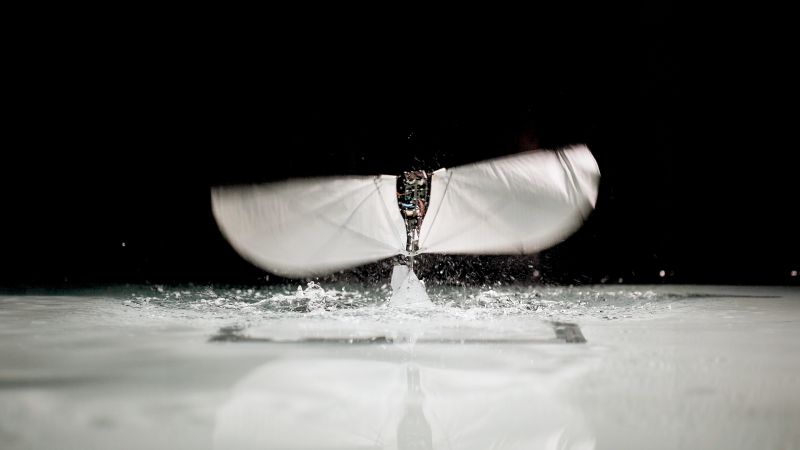
MIT’s Dual-Environment Robot Takes Flight and Dives Beneath Waves
Qwenews.com – A research group at the Massachusetts Institute of Technology has developed an affordable robotic device capable of navigating both air and water. Priced at approximately $300, this lightweight machine utilizes flapping wings to propel itself through different mediums. Its inventor envisions a future where such robots assist in ocean conservation efforts and environmental monitoring.
Biomimicry Meets Engineering Innovation
The engineering team drew inspiration from seabirds such as puffins and petrels, which employ their wings for propulsion across both aerial and aquatic environments. They analyzed how these creatures transition between mediums and mapped wing flap frequencies against wingspan measurements. Larger birds demonstrated lower flap rates compared to their smaller counterparts.
Raphael Zufferey, who serves as an assistant professor of mechanical engineering at MIT and led the study, noted that while prior investigations examined diving bird wings, no one had successfully converted those findings into a complete robotic system. “No one had ever figured out how to transform that into a fully moving robot,” he explained.
Technical Design and Performance
The resulting vehicle weighs 250 grams and features nylon wings alongside a tail treated with water-repellent nanoparticles. A battery-powered motor drives the mechanism. Contrary to what might appear, the design does not simply replicate bird anatomy. Water possesses significantly greater density than air, requiring different approaches to movement.
Diving birds partially fold their wings underwater to reduce amplitude and drag while maintaining forward momentum. Replicating this mechanism in a robot would necessitate additional joints, increased complexity, and greater weight. Instead, the MIT team engineered a more flexible wing that achieves similar results without folding.
The robot operates without distinguishing between air and water environments. It simply follows programmed instructions to maintain a specific wingbeat frequency regardless of the medium. Current capabilities include flight speeds exceeding 6 meters per second and swimming velocities approaching 1 meter per second. Theoretical ranges suggest 6 kilometers of flight or 2 kilometers of swimming per battery charge, though these figures remain unverified through testing.
Testing and Expert Validation
Researchers conducted extensive evaluations over twelve months, first within a Massachusetts water tank and subsequently in Lake Geneva, Switzerland. A critical component involved determining the optimal 70-degree angle for entering and exiting water. The current version functions adequately in moderate wind and wave conditions but struggles with rougher environments.
“From an engineering perspective, this is genuinely an impressive design,” remarked Maaten Furlong, director of engineering science at the National Oceanography Centre, who participated in no capacity with the project. “Developing a vehicle capable of operating effectively in both air and water is a significant technical challenge, and successfully integrating these two modes of operation is a notable engineering achievement.”
Future Applications in Oceanography
Following this initial success, the laboratory is seeking funding to advance the technology. Zufferey emphasized that while individual capabilities have been demonstrated, combining them into a single autonomous mission remains a work in progress.
“In this paper, we show that individually all of this is possible: we can fly, we can swim, we can transition, we can dive. But we haven’t been able to piece it all together in one autonomous mission,” he stated.
Scientific sampling operations at sea currently carry substantial costs, making this relatively inexpensive vehicle attractive for various applications. The robot could deploy from either terrestrial or maritime locations, following predetermined flight paths before submerging to gather specimens. Zufferey expressed particular interest in deploying these machines in hazardous environments, including toxic algae regions, volcanic lakes, and areas near icebergs.
Additionally, the platform could accommodate camera systems for wildlife observation purposes, expanding its utility beyond sample collection alone.
Related Reading
Frequently Asked Questions
What is MIT unveils a robot that flies?
MIT unveils a robot that flies is the main topic of this guide. The article explains the context, practical details, and next steps readers should understand.
Why does MIT unveils a robot that flies matter?
MIT unveils a robot that flies matters because readers are looking for a useful answer, not just a short summary. Good content should match search intent and help them decide what to do next.