
Understanding the Term “Lockdown” During the Pandemic Era
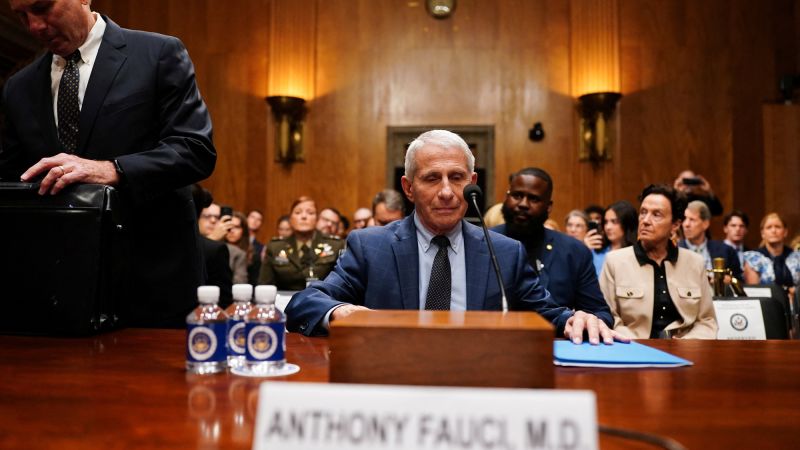
Qwenews.com – Recent congressional proceedings and media coverage have seen Republican legislators alongside Trump administration figures heavily criticize Dr. Anthony Fauci. These critics argue the former White House chief medical adviser contributed to avoidable hardship throughout the coronavirus crisis. Senator Rand Paul, representing Kentucky and organizing the session, charged that Fauci hid the virus’s beginnings and provided misleading information regarding its emergence. Furthermore, Paul contended that the medical expert responded with excessive, scientifically unfounded measures.
If there’s one thing I wanted to make clear to Anthony Fauci, it’s that he’s culpable for the lockdowns we all endured.
According to Paul and his political allies, one of Fauci’s most significant missteps involved implementing lockdown protocols. Following the July 29 session, the senator shared his perspective on the social media platform X. Over the weekend, Health Secretary Robert F. Kennedy Jr. added his criticism during a conversation with CNN’s Dana Bash.
President Trump, as you recall, wanted to end the lockdowns. I think the thing that did the most damage to our country was the lockdowns.
CNN Medical Correspondent Meg Tirrell subsequently examined the validity of statements Kennedy Jr. made during that interview. However, skepticism regarding pandemic-era restrictions extends beyond conservative circles. In March 2025, The New York Times podcast “The Daily” posed the question: “Were the Covid Lockdowns Worth It?” Princeton University political scientists Stephen Macedo and Frances Lee, who co-authored “In Covid’s Wake: How Our Politics Failed Us,” responded with a negative assessment.
Tracing the Origins of the Word
To understand the controversy, one must first define what “lockdowns” actually entailed. Journalists began employing this terminology on January 23, 2020, when covering Chinese officials’ decision to halt nearly all transportation within Wuhan, the outbreak’s epicenter. This approach, known as “fengcheng” or “sealing the city,” represented an unprecedented containment strategy. English-language publications rapidly embraced the term to characterize these restrictive measures.
The Guardian published a headline reading: “Coronavirus: panic and anger in Wuhan as China orders city into lockdown.” During subsequent weeks, Chinese authorities intensified movement limitations to slow viral transmission. Residential areas received continuous surveillance, personal vehicles faced usage restrictions, and residents required authorization before leaving their dwellings. Comparable stringent policies would later be applied across additional Chinese municipalities over the following two years.
Global and American Responses
While official government documents rarely utilized the term “lockdown,” news organizations adopted it as convenient shorthand for extraordinary precautions worldwide. Italy introduced localized restrictions in March 2020 before expanding them nationally. These measures kept citizens indoors except under exceptional circumstances, prohibited public assemblies, and closed educational institutions alongside nonessential commercial establishments. Spain and France implemented analogous strategies, as did India, which requested its 1.3 billion residents remain at home.
The United States approached containment differently, lacking a unified national framework. Instead, the nation relied on a decentralized system where state and local authorities determined their own protocols. This variation often correlated with political affiliation. California pioneered a comprehensive statewide directive on March 19, 2020, mandating home confinement and business closures for nonessential operations. Within weeks, 43 additional states adopted comparable guidelines between March and April 2020. Republican-governed regions generally removed limitations more rapidly than Democratic-controlled areas. Certain interventions persisted for mere weeks, while California’s endured for months.
Oxford University scholars evaluating international pandemic strategies placed America in the middle tier during 2020 and 2021. Principal investigator Anna Petherick emphasized that substantial differences between states complicated nationwide evaluation. By 2022, researchers concluded the United States maintained some of the least stringent coronavirus policies globally. Nevertheless, Americans continued referencing “lockdowns” in public discourse.
The term “lockdown” entered modern usage in 1973, originally describing the practice of confining inmates to their cells for security purposes. A New York Times article from 1974 subsequently employed the word in connection with an outbreak situation.
EDITOR’S NOTE: CNN’s “Word of the Week” brings you the meaning behind the words in the news.
Related Reading
Frequently Asked Questions
What is What were the Covid lockdowns really?
What were the Covid lockdowns really is the main topic of this guide. The article explains the context, practical details, and next steps readers should understand.
Why does What were the Covid lockdowns really matter?
What were the Covid lockdowns really matters because readers are looking for a useful answer, not just a short summary. Good content should match search intent and help them decide what to do next.