
A Mysterious New Fish Species Found in Alabama Cave System
Qwenews.com – When Dr. Matthew Niemiller ventured into Bobcat Cave near Huntsville last year, he anticipated encountering familiar residents. The cave already housed the southern cavefish alongside the Alabama cave shrimp and two distinct cave crayfish species. What emerged instead was an extraordinary creature never before documented by science—a peculiar fish that Niemiller considers potentially one of the most uncommon fish globally.
Distinctive Physical Characteristics
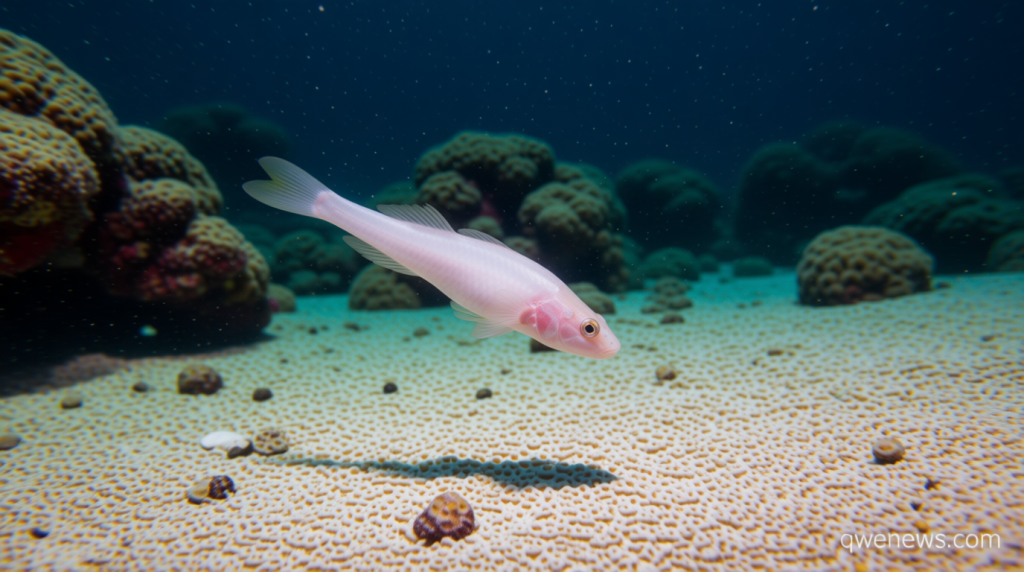
The newly identified species presents several remarkable features. It possesses no eyes, carries a pronounced hunchback, displays spiny rays, and exhibits a snout configuration unlike any other cavefish. Additionally, the organism lacks all pigment entirely. Under its see-through skin, observers can actually view the brain structure. According to Dr. Jonathan Armbruster, curator of fishes at Auburn University’s Museum of Natural History in Alabama, such transparency occurs occasionally in smaller aquatic creatures inhabiting open waters. “They’ll often have a clear body so that they can be cryptic in the clear waters,” Armbruster explained.
A Name Inspired by Science Fiction
The creature’s appearance evokes imagery from science fiction narratives. Appropriately, researchers have named it Demogorgonichthys arcanus, commonly called the demon cavefish. This designation references the fearsome monster Demogorgon from Netflix’s popular series “Stranger Things.” The word Demogorgon traces uncertain origins, possibly to Greek etymology, before being adopted by Dungeons & Dragons creators in the 1970s for one of their villains. Netflix later utilized the name for their television monster. When Niemiller discovered the fish, “Stranger Things” approached releasing yet another season. Armbruster, a devoted viewer of the show, proposed honoring the series with the naming. “What do you call a plain white, eyeless, rather nondescript thing? I mean, it’s hard to come up with descriptive names for something like that, and so what you’ll see is a lot of cave organisms have some kind of tie-in with underground creatures of some sort,” Armbruster noted.
Scientific Verification Process
Niemiller, the study’s lead author and associate professor of biological sciences at the University of Alabama in Huntsville, initially questioned whether the specimen represented a known species. “Over the years, I’ve seen how variable cavefish can be, and I’ve been fooled before by animals that looked different but were genetically very similar,” he recalled. “But this one was different in ways that kept holding up.” He transmitted photographs to Armbruster and Dr. Pamela Hart, an assistant professor of biology at the University of Alabama and another study coauthor. After examining specimens against the southern cavefish, Armbruster identified distinguishing traits. The research team conducted CT scans, genetic evaluations, and supplementary analyses revealing skeletal differences from other cave inhabitants. These findings led scientists to classify the organism as both a new genus and species.
Population and Habitat Details
Current estimates cannot determine the exact population of demon cavefish, though Niemiller suggests they rank among the world’s rarest fish. “The species is known from a single site based on our best knowledge with presumably a very small population size,” Niemiller communicated via text message. The research findings appeared July 6 within the journal Scientific Reports. Bobcat Cave sits beneath the US Army’s Redstone Arsenal, an access-restricted military installation. The study indicates such environments may harbor additional unidentified species even within thoroughly examined regions.
Unanswered Questions Remain
Little information exists regarding this cavefish’s biology. Scientists cannot differentiate between male and female specimens and possess “zero clue” about reproductive methods, according to Armbruster. Regarding diet, the demon cavefish probably consumes anything small enough to fit inside its mouth. Dr. Suzanne McGaugh, a University of Minnesota professor specializing in cavefish evolution, characterized discoveries of new North American vertebrate species like the demon cavefish as “exceedingly rare.” She found it remarkable that two cavefish species coexist within the same cave despite evolving through independent pathways from distinct ancestors.