
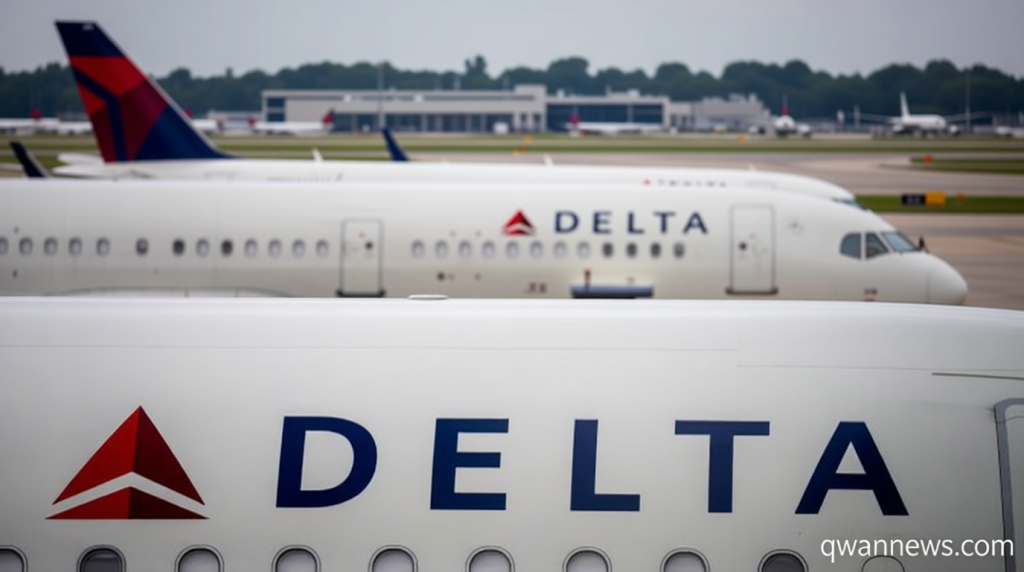
Anti-Collision Alarms Sound in Delta Planes After Atlanta Close Call
Qwenews.com – Anti collision alarms sound in the cockpits of two Delta aircraft following a tense near-miss at Hartsfield-Jackson Atlanta International Airport, one of the world’s busiest aviation hubs. According to air traffic control audio captured during the incident, Delta flight 1568 was executing a landing approach when it detected another aircraft on the runway. The pilot immediately initiated a go-around maneuver, but not before the proximity alert systems activated in both planes. This dramatic moment was captured on audio recordings that have since been made available to the public through ATC.net.
Delta flight 1568, operating from Pittsburgh, had been experiencing challenging weather conditions throughout its journey. Bad weather forced the aircraft to divert to Chattanooga, Tennessee, where it remained for approximately two hours before continuing to Atlanta. By the time the plane arrived in Atlanta, conditions had improved enough to attempt a landing. However, as the aircraft descended toward the runway, air traffic controllers noticed another Delta plane was still taxiing on the active runway. “Somebody on the runway?” the pilot queried the tower, seeking clarification about the situation below.
Resolution Advisories Activate in Both Cockpits
The tower controller responded that the aircraft was exiting the runway, but the pilot of flight 1568 remained cautious. Concerned that the other plane might not clear the runway quickly enough, the pilot announced they were “going around” and would circle the airport for another landing attempt. Meanwhile, Delta flight 2472 had just departed from a parallel runway and was climbing toward its assigned altitude. The controller instructed the departing aircraft to turn right and climb to 4,000 feet, a maneuver that would place it directly in the path of the incoming flight 1568.
As both aircraft adjusted their positions, anti-collision alarms, technically known as resolution advisories, began sounding in the cockpits of both planes. These critical warning systems alert pilots when their aircraft are on a potential collision course and recommend specific maneuvers to avoid danger. The pilot of Delta 1568 repeated “Delta 1568, going around” on the radio while also being directed to turn right and climb to 4,000 feet, mirroring the instructions given to the other aircraft. The timing of these maneuvers created a critical moment where both planes were navigating simultaneously in close proximity.
Flight tracking data from Flightradar24 revealed that at their closest point, the two Delta aircraft were separated by approximately 1,800 feet horizontally and about 600 feet vertically. This narrow margin, while within acceptable safety parameters, was certainly enough to trigger the resolution advisories in both cockpits. The air traffic controller quickly directed both aircraft away from each other, ensuring they maintained safe separation as they continued their respective operations. The incident occurred late Monday evening, adding to the complexity of managing multiple aircraft during evening operations.
Delta Air Lines issued a statement addressing the incident, emphasizing the thorough training their flight crews receive. “During the go-around, the flight crew maneuvered in accordance with established procedures while maintaining safe operations,” the airline stated. “Our crews train extensively to handle uncommon scenarios like this.” The statement highlighted the professionalism and preparedness of Delta’s pilots and ground staff in managing the close call. The Federal Aviation Administration also released a statement confirming that it would conduct a thorough investigation into the incident to determine all contributing factors and ensure proper safety protocols were followed.
The activation of anti collision alarms sound in both cockpits serves as a reminder of the sophisticated safety systems that protect millions of passengers daily. These resolution advisories, part of the Traffic Collision Avoidance System (TCAS), have been instrumental in preventing numerous potential accidents throughout aviation history. The Atlanta incident, while not resulting in any injuries or damage, demonstrates how these systems work together with air traffic control and pilot decision-making to maintain safety in busy airspace. As investigations continue, the incident will likely be studied as an example of effective emergency response and the importance of maintaining vigilance in high-traffic airport environments.