
Qwenews.com – “`html
A moment in time: Fossil Footprints Rewrite Nutcracker Man History
A moment in time has been captured in the ancient mud of Kenya, where scientists have fundamentally revised our understanding of “Nutcracker Man” — an extinct hominin species scientifically classified as Paranthropus boisei. This remarkable human relative, nicknamed for its massive teeth and powerful jaw muscles, lived across eastern Africa between 2.3 million and 1.2 million years ago. Fresh analysis of fossil footprints reveals that P. boisei was significantly taller and heavier than previously estimated, and likely maintained more complex social relationships than researchers once believed.
Updated Measurements Reveal Larger Nutcracker Man
Previous estimates based on P. boisei fossil evidence suggested males averaged approximately 4.2 feet (131 centimeters) in height and weighed around 108 pounds (49 kilograms). However, updated calculations derived from the length and width of 21 newly identified P. boisei footprints paint a different picture. These revised measurements indicate that Nutcracker Man could reach up to 6 feet (1.8 meters) tall and weigh as much as 165 pounds (75 kilograms), making their physical stature more humanlike than previously understood.
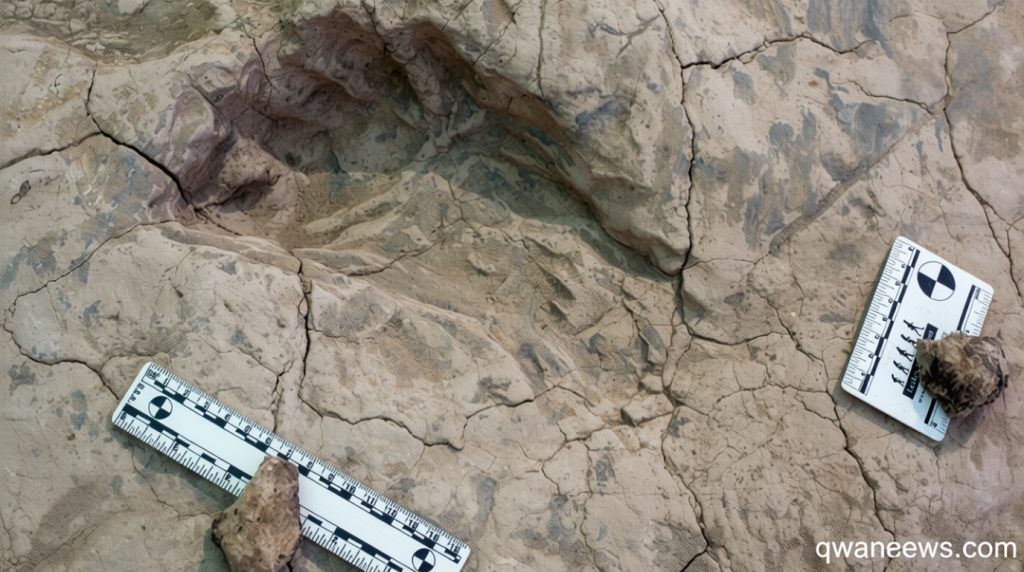
Patterns within the footprints further reveal that the tracks belonged to eight P. boisei individuals who traversed East Turkana’s Koobi Fora Formation simultaneously, traveling together as a cohesive group.
“Each set of footprints like this one provides a window to a moment in time when we can directly observe how hominins were living, and engaging with their environments,” said lead study author Kevin Hatala.
Social Structure and Environmental Context
These preserved prints offer valuable insights into the complexity of P. boisei social structure within their lakeside habitat, according to researchers who published their findings Monday in the journal PNAS. Kevin Hatala, associate professor of biology at Chatham University in Pittsburgh and associate researcher at the Max Planck Institute for Evolutionary Anthropology in Leipzig, Germany, emphasized the significance of these discoveries.
“We think that the footprints may capture a group of adult males moving together along the lakeshore,” Hatala explained, noting that threats from dangerous animals such as hippos could account for why the group consisted exclusively of adult males. Patricia Kramer, professor in the department of anthropology at the University of Washington in Seattle and affiliate curator of archaeology at the Burke Museum, praised the research. Kramer, who has previously studied these trackways though was not involved in the new research, told CNN: “I am excited that the authors have provided additional information and analysis about the trackways at Koobi Fora.”
The tracks, dating to approximately 1.4 million years ago, display well-defined impressions with depths reaching 0.4 inches (12 centimeters). The authors report that these footprints were likely pressed into mud within shallow lake water. Seven tracks were originally uncovered in 1978 through fieldwork directed by senior study author Anna Katherine “Kay” Behrensmeyer, a senior research geologist and curator of vertebrate paleontology at the Smithsonian’s National Museum of Natural History in Washington, DC.
Subsequent excavations in 2016 and 2023 revealed 14 additional hominin footprints, alongside tracks left by animals including antelope and hippos. P. boisei was not the sole archaic human relative inhabiting the Lake Turkana region.
For hundreds of thousands of years, P. boisei coexisted with Homo erectus. A 2024 study led by Hatala documented the discovery of fossil footprints in Kenya’s Turkana Basin created no more than a few days apart by two distinct hominin species. Researchers hypothesized that these prints belonged to both H. erectus and P. boisei. “We can’t say how the two different hominins interacted on the mudflats, but we know they were both here at this time,” Behrensmeyer stated in a press release.
Homo erectus represented the earliest relative of Homo sapiens to share body proportions similar to modern humans, demonstrating adaptation to upright walking. In contrast, P. boisei, a more distant cousin of modern humans, possessed physical characteristics that more closely resembled those of our tree-dwelling primate ancestors.
Impressions created by P. boisei feet bear resemblance to footprints produced by H. erectus and modern humans. Nevertheless, several distinguishing features set P. boisei tracks apart, according to Hatala. Prior research examining hominin footprints from the early Pleistocene period (2.6 million to 11,700 years ago) — when P. boisei existed but H. erectus did not — revealed that these prints possessed flatter arches than those made by H. erectus and modern humans.
While this observation does not definitively prove that older hominins had flatter feet, “it at least tells us they moved their feet against the ground in a different way,” Hatala clarified. “We’ve also found that those same footprints tend to have a big toe that is more angled away from the other toes,” he added. “Both of these features differ from what we usually see in modern humans.”
“`