
Qwenews.com – “`html
A New Chapter for IndyCar: Racing in the Nation’s Capital
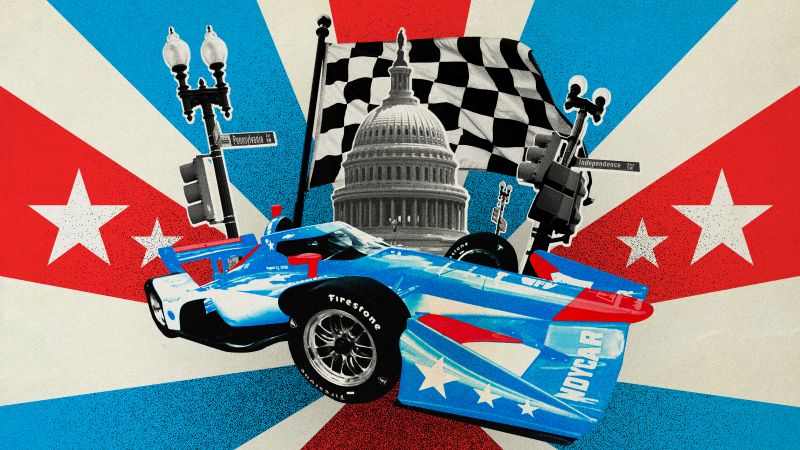
Washington, DC is preparing to welcome its inaugural IndyCar competition this August. The Freedom 250 Grand Prix will transform the heart of the city into a professional racing venue, marking a milestone moment for motorsports in the United States capital. This ambitious undertaking represents more than just another stop on the racing calendar—it embodies a convergence of sport, politics, and national celebration.
From Casual Suggestion to Grand Vision
What began as a passing comment during a business dinner has evolved into one of the most complex sporting events ever staged in Washington. Bud Denker, who serves as president of Penske Corporation, recalls the evening when he and Fox Sports CEO Eric Shanks pondered ways to honor America’s 250th anniversary. “We said, ‘What can we do to celebrate our country’s 250th anniversary?'” Denker shared with CNN.
At first glance, the proposal seemed almost comical—an offhand notion that might never materialize. Yet Denker felt compelled to explore the possibility further. He journeyed to the capital secretly, keeping the endeavor hidden even from his employer, Roger Penske. Walking through the sweltering summer streets, he visualized a racing circuit weaving through the city’s most recognizable landmarks.
Navigating Bureaucratic Labyrinths
The initial course design encircled iconic destinations such as the Washington Monument and the United States Capitol. However, constructing a race track in this environment presented numerous complications beyond mere geography. “The hardest problem in designing an urban race is, where do you put a pit lane?” Denker explained to CNN, highlighting the quarter-mile corridor essential for team operations and vehicle maintenance.
Logistical concerns multiplied quickly. “And where do you put my 100 trucks that have to come to support the race?” he questioned. Denker initially identified an ideal location adjacent to the Capitol—a spacious area featuring broad thoroughfares surrounding historic buildings. The uphill section would provide additional difficulty for competitors navigating the circuit.
Yet Washington’s political machinery proved formidable. Because the original route crossed Capitol grounds, it required approval from both parties in Congress. In the current polarized era, securing bipartisan consensus seemed nearly impossible. The difficulty of obtaining necessary votes brought Denker close to abandoning his vision entirely.
A Clever Solution Emerges
Patience and creativity ultimately prevailed. By shifting the course one block westward, Denker successfully bypassed congressional oversight. President Donald Trump subsequently authorized the event through an executive order issued in January. Now, after a year of intensive planning, the dream appears destined to become reality.
The Freedom 250 Grand Prix joins an extraordinary summer lineup in the capital. Other attractions include a mixed martial arts bout contested on the White House lawn, a festival held on the National Mall, and what organizers describe as the largest fireworks presentation ever assembled.
Building a Race in the Heart of Power
Converting downtown Washington into a 1.66-mile circuit demands extensive infrastructure work. Open-wheel vehicles will reach velocities approaching 180 mph, requiring protective barriers and spectator viewing zones that must be erected before the event and dismantled afterward. The total investment exceeds $35 million, entirely funded by IndyCar, making this one of the series’ costliest competitions. General admission remains complimentary for fans.
Security considerations demanded particular attention, ensuring that President Trump and his Cabinet could potentially participate in the festivities. Negotiations with municipal authorities and local residents addressed anticipated road closures spanning approximately two months—one of the most heavily trafficked urban centers in the country.
Politics and Motorsports Collide
While sports organizations typically strive to remain neutral, this race cannot escape the political spotlight. Trump’s participation may alienate certain segments of IndyCar’s audience and even some drivers. McLaren Racing’s Pato O’Ward, the series’ sole Mexican competitor, remarked that victory would be “ironic” given the president’s political stance.
Denker maintains that inclusivity defines his approach. “I want the entire city, I want all of Congress to be part of this event,” he stated. “I don’t have exclusive areas for anybody that’s red or blue.”
Dedication to a New Era
Over the past twelve months, Denker has devoted considerable time to Washington, frequently spending three days each week in the capital. He secured both residential quarters and professional office space within the city. Though his primary responsibilities encompass leading Penske Corporation, overseeing the Indianapolis Motor Speedway, and managing the IndyCar championship, he views this endeavor as essential to expanding the sport’s reach.
“I’m not a licensed lobbyist, but I’ve sure felt like it over the last eight months,” Denker observed. “I feel he has ‘an obligation to help grow the Indycar Series’ with something as audacious as a race in the middle of the nation’s capital.”
As August approaches, Washingtonians and visitors alike will witness whether this bold experiment succeeds in blending high-speed competition with the unique challenges of hosting a major sporting event in America’s political center.
“`