
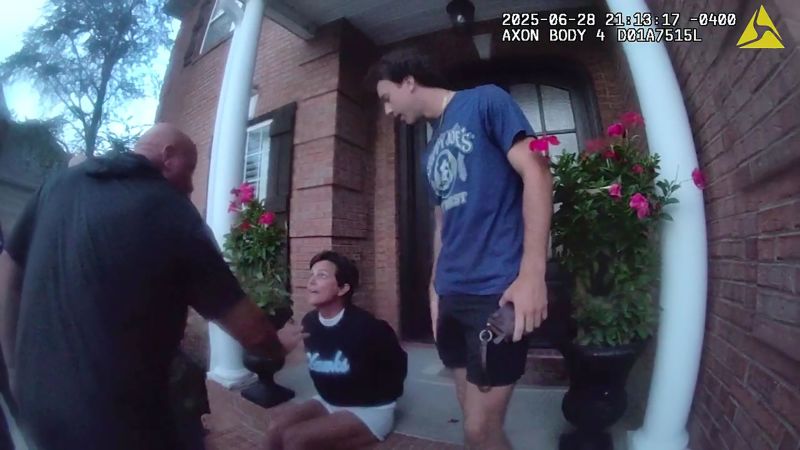
Qwenews.com – Donna Dillon and her husband were winding down and getting ready to watch Netflix after spending an ideal summer evening in their home’s pool with their four children. Then they heard a bang at the door. Dillon peered out the window at her usually quiet Knoxville, Tennessee, cul-de-sac and saw around 10 officers in the driveway, along with a cameraman filming for the “On Patrol: Live” police television reality show, she said.
“Is Jacob OK?” Dillon yelled as she came out in a panic, thinking something happened to her son who had just left home, body camera footage showed. The expression on her face changed from concern to pure shock as an officer came behind her and put her arms in handcuffs, the video showed. Restrained on her front steps next to her 17-year-old son, Dillon learned she was under arrest on a 3-year-old warrant she says she didn’t know existed and stemmed from a dismissed misdemeanor charge.
“If this is on any social media, you all are going to be in trouble,” Dillon told the officers. She pleaded with the officers to handcuff her arms in front to avoid causing her pain because she was recovering from shoulder replacement surgery, the video showed. While they changed the handcuffs after about 5 minutes, Dillon was kept in that agonizing position for more than four hours in the back of a patrol vehicle, she said.
A year after her arrest, Dillon filed a lawsuit in June against Knox County, the sheriff and four deputies, alleging the frightening ordeal only happened because they were filming for the show and used a stale warrant to make “dramatic content.” About a week before the lawsuit, the sheriff’s office announced it would no longer participate in the show, without providing a reason. Legal representatives for the sheriff’s office declined to comment on the case due to pending litigation. The sheriff’s office wrote on social media the show was an opportunity to “share a glimpse into the commitment and sacrifice of the men and women who proudly serve this community” while acting with “professionalism, compassion, and dedication.” Such police reality TV shows have long faced criticism over allegations they exploit real people with increased risk-taking for “made-for-television” arrests and present ethical problems, often at the expense of marginalized communities.
Just last year, a Maryland man sued police and the producers of “On Patrol: Live,” alleging he was wrongfully arrested and portrayed in a false light in an aired episode. In 2024, a Texas county agreed to pay $2.5 million to a resident who claimed the sheriff’s office staged his son’s arrest in 2020, broadcast on a similar show called “Live PD.” But even when the camera footage doesn’t air on a police reality television show, like in Dillon’s case, the fallout can still be damaging. “When there’s an entertainment value attached… You push aside all of these other considerations that come into play about people’s humanities and rights,” said Brandon Golob, professor of criminology, law and society at the University of California, Irvine.
Law enforcement officials who support collaborating with such shows say there’s value in sharing a real-life, unfiltered glimpse into their profession with the public and highlighting how they serve communities. “Seeing it all as it really happens allows the public to reach their own conclusions and form their own ideas and opinions,” said Lawrence Police Department Capt. Tracey Cantrell, whose agency also participated in “On Patrol: Live.” But others in law enforcement have turned down requests to be featured on these programs, arguing their profession is not entertainment.
When he was the Washington, DC, police chief for nearly a decade, Charles Ramsey declined to partner with a police reality television show. The work is serious, can be dangerous and it’s not fair for people officers encounter who are going through a crisis to be filmed, Ramsey said. “This is real stuff,” said Ramsey, also a CNN law enforcement analyst.
“Hauling around a camera crew is not something that I think is in the best interest of the department, the citizens, the city, anybody.” The events of that summer night in June 2025 still flash daily in Dillon’s mind. She underwent therapy and had to start over in her post-surgery recovery after it was exacerbated by her arrest, Dillon said. “I’ve just always been a baseball mom, I’ve been everybody’s mom, everybody’s grandmother.
We have so many friends,” Dillon said. “It’s affected our family. I was embarrassed to go out in public, and just the fear that it caused me.” Dillon says she was confused as she tried to tell officers questioning her that she wasn’t a threat.
At first, an officer told Dillon she was being arrested on a misdemeanor domestic assault charge, the footage showed. But a few minutes later, the officer said the charge was not domestic-related, but rather for a 2022 warrant on misdemeanor assault, according to the footage. The charge, which has since been dropped, was related to a dispute Dillon had with her former neighbors who had since moved and did not pursue the case, her lawsuit said.
She says it was based on a false accusation. One of the key allegations in Dillon’s lawsuit is that deputies used excessive force during the arrest, despite her pleas, leaving her with pain, swelling and a loss of range of motion in her surgically repaired shoulder when she was handcuffed for four hours. She further alleges she was denied medical care when she arrived at the jail, where she stayed for over seven hours.
The Knox County sheriff later informed Dillon that the driver of the patrol vehicle was suspended for three days “for keeping her confined in the van for an extended time,” the suit said. Dillon is seeking compensatory and punitive damages for violations of her rights protected by the Fourth and 14th Amendments. Police departments on “On Patrol: Live” don’t have editorial control over the show’s content, but they do have the right to review and request editing of footage that could potentially endanger citizens and officers or compromise departmental operations, according to the show’s network, Reelz.
While production for the show declined to comment, a source close to the producers confirmed to CNN the footage of Dillon’s arrest never aired and there are no plans to do so. Still, Dillon’s lawsuit accuses the sheriff’s department of “timing or staging warrant service and arrests to create dramatic, broadcast-worthy encounters” for “On Patrol: Live.” The county and deputies involved signed an acknowledgement of the lawsuit on July 9, giving them 60 days to file an answer or motion. Dillon’s lawsuit comes amid a modest resurgence of such police reality TV shows after a brief — but sudden — lull, spurred in part by a deadly arrest and another suit that says law enforcement also acted more brazenly in the presence of a camera crew.
In that case, the family of Javier Ambler filed a lawsuit against Williamson County in Texas for his wrongful death, alleging the sheriff encouraged officers to “engage in dangerous, high-risk police tactics because it made for more entertaining television in service to Live PD.” A camera crew for “Live PD,” the predecessor to “On Patrol: Live,” was riding along with deputies when they tried to stop Ambler, a Black man, for a traffic violation in 2019. The incident escalated to a vehicle chase and ended with two Williamson County officers tasing Ambler, who was physically restrained and handcuffed, as he said multiple times he couldn’t breathe and had congestive heart failure, court documents said. Ambler died after the arrest and his death was ruled a homicide.
No footage from that night was aired. Cancellations of both “Live PD” and “Cops” came in response to outrage over revelations the arrest was filmed — and during a shift in public perception of police after the murder of George Floyd in 2020, which led to nationwide protests against police killings and racism. A&E attributed the “Live PD” decision to “respect for the families of George Floyd and others who have lost their lives.” But the shows didn’t disappear for long.
“Cops” returned to air in 2021 under the Fox Nation streaming service and “Live PD” came back in 2022 as a reboot under the new name “On Patrol: Live.” “They all came back in different iterations, and so it suggests that the cycle is perhaps self-reinforcing or resilient” to public pressure and moments of accountability, Golob said. “The 2020 cancellations may have removed the shows from traditional networks, but less regulated streaming platforms were quick to swoop in to meet the demand.” Most states lack laws governing camera crews on police ride-alongs — aside from Texas, which has a statewide ban prompted by Ambler’s death — and there’s no federal regulation, he added. Williamson County agreed to pay a $5 million settlement after the lawsuit from his family and both officers involved in the arrest were later cleared on all charges, including manslaughter.
The Williamson County Sheriff’s Office told CNN its “current administration does not plan to participate in ‘Live PD’” or similar TV programs in the future and is focusing “solely on serving and protecting our community.” Ambler’s arrest filmed on camera became a flashpoint in the national conversation about race and policing, experts said, in part due to the disparities in police reality television shows. Research has shown they disproportionately depict Black and Hispanic people as criminal suspects while White characters are more often portrayed as police officers who were also more likely than suspects “to engage in aggressive behaviors.” Still, the demand for such shows brought them back to life. Their resurgence since 2020 has in part been driven by an opposing reaction to anti-police movements, said Daniel LaChance, a legal scholar at Emory University and co-author of “Crimesploitation.” “There’s a hunger out there from folks who are conservative, pro-law enforcement and are looking for positive representations of police that also reaffirm the basic ways they think about crime.” As someone who had always been pro-police and a supporter of the Blue Lives Matter movement, Dillon said her first negative experience with law enforcement has upended her views.
“It’s just taken away all my sense of trust and security. I just want accountability,” she said. Dillon’s case isn’t just about one person’s experience, but it’s a “window into this systemic media effects problem,” Golob said.
Scholars have used the term “copaganda” to describe how police officers in these shows are often portrayed in a purely heroic light without the complex reality of crime and policing, according to Golob. Former law enforcement officials like Ramsey who oppose working with such shows believe that, in some cases, when an officer knows they are on camera, it can change their behavior, he said. There’s “unspoken pressure” as part of the natural dynamic of such shows for police to deliver content that is curated and might not otherwise occur if the filming was purely documentary, said LaChance.
Dillon’s case is just one example of how “copaganda pushing too far” can backfire on law enforcement, according to Paul Kaplan, professor of criminal justice at San Diego State University. The ordeal displayed the inherent risks of the phenomenon, with officers “bringing too much weight or heat to a very non-serious kind of situation,” according to Kaplan, who co-authored “Crimesploitation” with LaChance. Dillon and her husband, who was a high school baseball coach for nine years, are heavily involved in their community, she said.
But she retreated after the arrest, fearful and recovering from an incident she describes as “horrific.” “They were so ugly to me,” Dillon said. “It was so obvious that it was just for fame. It wasn’t for justice.
They came in on my neighborhood like I had killed someone.”