
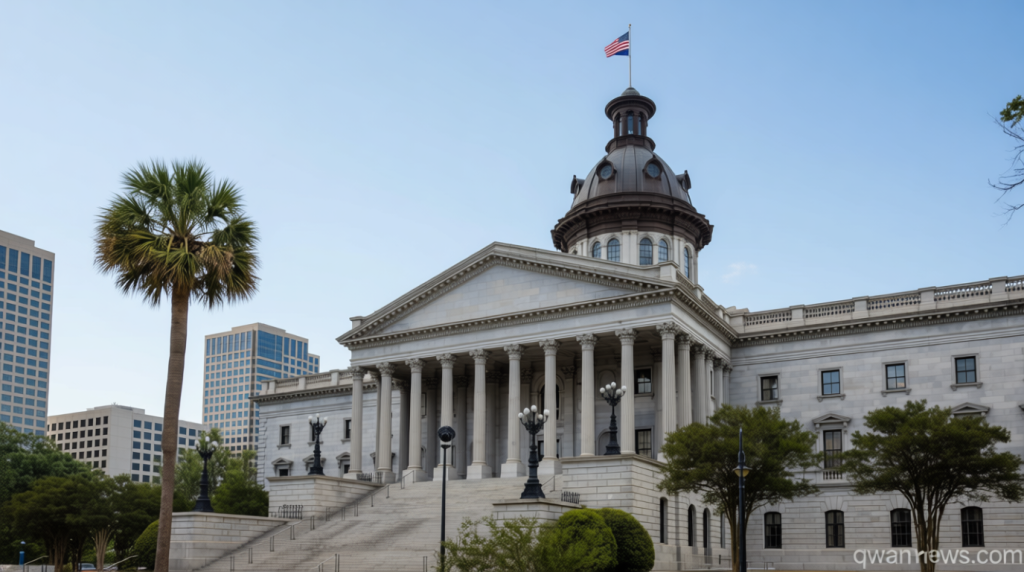
South Carolina Selected for 2028 Democratic Primary Opening
Panel Decision Prioritizes Black Voter Influence
Qwenews.com – South Carolina picked by DNC panel to lead the 2028 presidential primary race, according to a final recommendation from the party’s Rules and Bylaws Committee. The decision places South Carolina at the forefront of the Democratic nomination process, ensuring continued prominence for Black voters in the party’s electoral strategy. The announcement followed months of competition among four states—Nevada, South Carolina, New Hampshire, and Iowa—vying for the coveted first position.
The Rules and Bylaws Committee spent considerable time deliberating which states should host early contests before Super Tuesday. South Carolina secured the opening slot on January 22, 2028, with Nevada scheduled for February 1, New Hampshire for February 8, New Mexico for February 15, Michigan for February 22, and Virginia for February 29. The broader primary calendar will commence with Super Tuesday on March 7.
Committee Deliberation and Voting Results
The full Democratic National Committee will consider the committee’s recommendations when members convene in August. The selection process proved contentious, with the panel split between Nevada and South Carolina for the inaugural primary position. Committee members held extended discussions during a Thursday evening dinner that continued past midnight before reaching a conclusion.
South Carolina won the vote with 26 out of 49 total ballots cast, including the tiebreaking votes from the committee’s co-chairs. Nevada received 19 votes, while New Hampshire garnered four. This outcome reflects the committee’s emphasis on maintaining strong Southern representation in the primary sequence.
Coalition Building and Voter Priorities
The debate centered on balancing two critical voter groups: Black voters, who remain among the party’s most loyal supporters, and Latino voters, who showed declining enthusiasm for Democrats during the 2024 election cycle. Proponents of South Carolina argued that the party must strengthen its commitment to Black voters, whose political power has faced challenges from redistricting and a recent Supreme Court decision affecting the Voting Rights Act.
Several committee members pointed to Black Americans’ long history of advancing voting rights and stressed the importance of building Democratic strength across Southern states. The decision to place South Carolina first signals the party’s intent to prioritize this demographic in the nomination process.
“The South is not the past, it is the future,” said South Carolina Democratic Party chair Christale Spain, a member of the RBC. “And if we are serious about changing this country, Democrats have to start winning in the South.”
Nevada’s Arguments for Early Position
Nevada’s supporters emphasized the state’s diverse population, which includes substantial Black, Latino, Asian American and Pacific Islander, Native American, and White working-class communities. Nevada also differs from South Carolina by serving as a competitive general election battleground state.
“There’s a lot of riding on the decisions we make here today,” said Daniele Monroe-Moreno, the chair of the Nevada Democratic Party and an RBC member. “I personally believe, and I guess I’m biased, that that coalition that our presidential candidate will need to build to win the White House back in 2028 starts in Nevada.”
Some committee members raised concerns about Nevada’s vote-by-mail system, which allows late ballots postmarked by Election Day to be counted. South Carolina advocates argued their state can deliver results more quickly on election night.
“Candidates, particularly candidates in early states, want to get those vote totals, spin those vote totals to their own advantage, and take some momentum to the next state,” said Carol Fowler, an RBC member from South Carolina.
Nevada representatives maintained that their voting procedures benefit working-class voters rather than creating obstacles.
“We should not be penalized as a state for making it easier for working people to vote,” said Artie Blanco, an RBC member from Nevada.
Background and Process
After the 2020 presidential election, Democrats instituted a waiver requirement for states seeking early primary positions. Before the 2024 cycle, the DNC designated South Carolina as the first primary state following a request from then-President Joe Biden. For 2028, twelve states submitted applications for early window positions, with South Carolina ultimately selected by the DNC panel.
This story has been updated with additional information.