
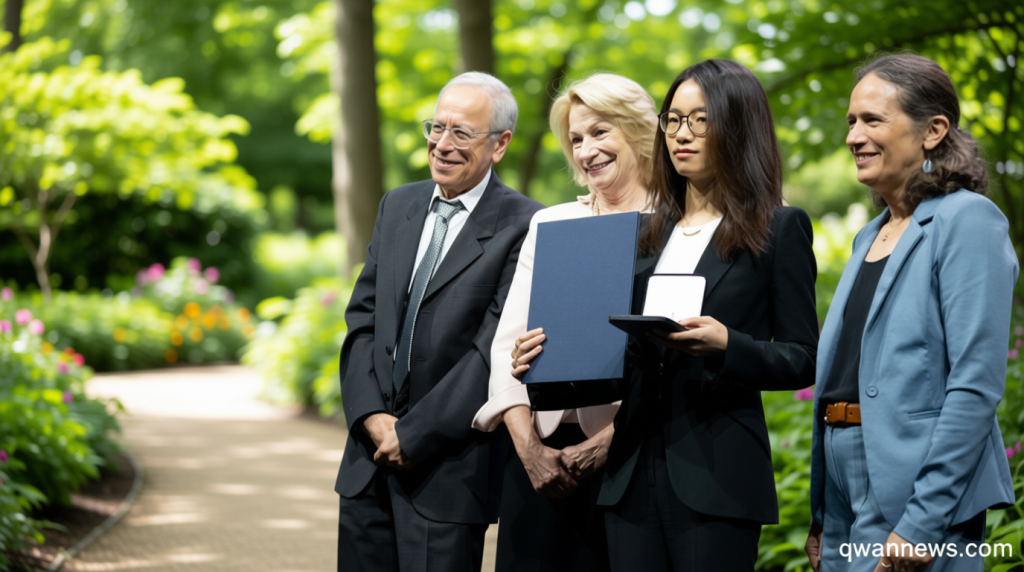
In a First: Two Chinese Win Fields Medal Honor
Qwenews.com – In a first two Chinese scholars have achieved what many considered impossible. Wang Hong and Deng Yu were announced Thursday as recipients of the Fields Medal, the most prestigious award in mathematics. The quadrennial honor recognizes exceptional mathematical contributions from scholars under 40, presented by the International Mathematical Union. This historic moment has captivated the nation and sparked widespread celebration across social media platforms.
A Nation Celebrates
Weibo, China’s leading social network, saw the news dominate trending topics on Friday morning. State-run broadcasters and digital news outlets published numerous pieces examining the significance of this dual achievement for the nation’s scientific ambitions. One widely shared commentary captured the sentiment of many: “This is a landmark achievement for Chinese mathematics.” The post, which garnered thousands of views, continued, “It’s the realization of a dream generations of Chinese mathematicians have shared: building China into a mathematical powerhouse!”
Breaking Barriers for Women in Science
Wang Hong’s victory carries particular significance as she becomes only the third woman to receive the Fields Medal in its ninety-year existence. Some observers viewed her success as a powerful rebuttal to persistent gender stereotypes in mathematics. One social media user remarked that her accomplishment served “a hard slap in the face to those who have long preached that boys are better at mathematics than girls.” This perspective resonated with many Chinese netizens who celebrated Wang’s breakthrough for women in STEM disciplines.
Academic Excellence and Global Careers
Despite their Chinese heritage, both laureates have built their academic careers internationally. Wang, now thirty-five, serves as a professor at New York University and the Institut des Hautes Études Scientifiques in France. Originally from Guilin in southern China, she earned recognition for resolving a longstanding problem within harmonic analysis and geometric measure theory.
Deng Yu, aged thirty-seven, holds a professorship at the University of Chicago. Growing up in Shenzhen, China’s technology center, he received the honor for his contributions to partial differential equations. Both scholars completed their undergraduate education at Peking University, one of Beijing’s premier research institutions, before pursuing advanced studies abroad.
Deng transferred from Peking University to the Massachusetts Institute of Technology as an undergraduate student and subsequently earned his doctorate from Princeton University in 2015. Wang completed her master’s degree overseas following her graduation from Peking University.
Context: China’s Scientific Ambitions
The enthusiastic response reflects the profound value placed on academic accomplishment in Chinese society. Leading scientists often achieve celebrity status, and students participate in one of the world’s most demanding university entrance examinations each year.
This excitement also underscores China’s persistent desire to position itself among the leading nations in modern science and technology. Beijing has invested heavily in recruiting top academic talent and supporting innovative research as part of what officials term “national rejuvenation.” Leaders envision establishing the country not merely as a technology leader, but as a dominant force in fundamental and theoretical sciences as well.
State media commentary highlighted how the achievements of Wang and Deng challenge existing perceptions. One article noted that “for a long time, there has been a stereotype in Western academia: China excels in competitive and applied mathematics, but lacks original breakthroughs in cutting-edge fundamental theories.” The piece concluded that “The emergence of Wang Hong and Deng Yu has finally filled this gap, marking a new standard for Chinese mathematics and effectively breaking down prejudices.”
Historical Precedent and Future Hopes
Chinese state media identified Wang and Deng as the first Chinese citizens to receive the Fields Medal. Shing-Tung Yau, a scientist born in China, won the prize in 1982, though he held different citizenship at that time. Terence Tao, an ethnically Chinese mathematician born in Australia, also received the award in 2006.
In a Thursday interview with a Chinese state-affiliated media organization, Yau, currently a professor at Tsinghua University in Beijing, characterized the recent awards as the fulfillment of a decades-old aspiration within the Chinese mathematics community. He expressed hope that both laureates would eventually return to China to teach.
“We