
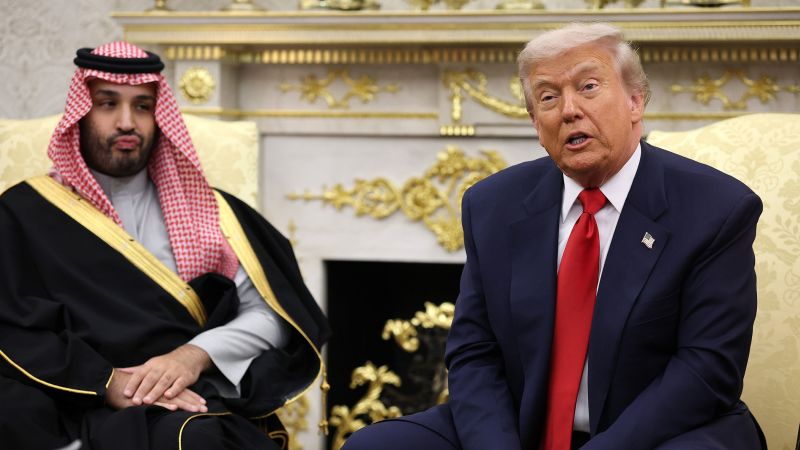
Trump Greenlights Saudi Nuclear Agreement Enabling Fuel Enrichment
Qwenews.com – President Donald Trump has given his approval to a landmark nuclear arrangement with Saudi Arabia, permitting the kingdom to enrich its own fuel supply for civilian power reactors while bypassing what many consider the “gold standard” of international monitoring, according to two American officials and another source knowledgeable about the matter.
Spanning three decades, the agreement may be unveiled as early as Wednesday, one US official stated, noting that American corporations will supply both technological capabilities and specialized knowledge to help develop Saudi Arabia’s nuclear infrastructure.
Key Provisions and Safeguards
Before any uranium enrichment commences, a combined American-Saudi committee will evaluate whether the process makes commercial sense and is justified. American workers will construct the enrichment facility while keeping sensitive technology within US control rather than transferring it to Riyadh.
Under terms first reported by the Wall Street Journal, the agreement prohibits Saudi Arabia from creating its own enrichment capabilities or acquiring them from foreign nations for ten years. The arrangement also establishes boundaries regarding the scope of inspections that can be conducted on the Saudi nuclear program, a provision that might generate skepticism among legislators, according to officials and sources.
Notably, Saudi Arabia faces no obligation to adopt the Additional Protocol with the International Atomic Energy Agency—the same framework the United Arab Emirates embraced in 2009 when concluding its “gold standard” nuclear cooperation agreement with Washington. Riyadh had historically resisted signing this protocol due to worries that inspectors might theoretically gain access to Mecca or royal residences.
Instead, the deal incorporates a bilateral safeguards arrangement mirroring the model protocol but excluding elements that previously troubled Saudi Arabia, a US official explained to CNN. The IAEA Board of Governors must still approve the agreement’s terms.
Regional Implications and Historical Context
Any accord granting Saudi Arabia access to nuclear technology carries potential for controversy both within the United States and across the broader Middle East, since fuel enrichment capabilities could theoretically pave the way for nuclear weapons development. The Trump administration plans to forward the agreement to Congress following its public announcement.
CNN previously noted that the administration allowed the deal to stall for several months amid concerns about the ongoing Iran conflict and the possibility of congressional rejection.
Israel, widely recognized as possessing undeclared nuclear capabilities, has maintained long-standing caution regarding Saudi access to nuclear technology. Meanwhile, Iran—Saudi Arabia’s primary regional competitor—holds a substantial stockpile of enriched uranium and has committed to maintaining its nuclear program despite months of American military strikes, asserting that the initiative serves civilian purposes.
Saudi Crown Prince Mohammed bin Salman has publicly committed to pursuing nuclear weapons should Iran ever develop them. Uranium enrichment and plutonium reprocessing represent the two primary routes for producing the essential materials needed to construct nuclear arms.
Most nations operating civilian nuclear reactors that require enriched uranium do not generate it domestically; instead, they acquire the material from suppliers such as the United States or Russia, receiving it in sealed containers under rigorous international supervision.
From Biden to Trump: A Long Road to Agreement
American interest in a Saudi civilian nuclear arrangement stretches back years. During the Biden administration, such an arrangement was considered integral to a larger normalization agreement between Saudi Arabia and Israel. Those negotiations encountered difficulties following the Hamas terrorist attacks on October 7, 2023.
The Trump administration revived nuclear discussions last year, moving forward with what had previously stalled.
Davis Winkie’s reporting at CNN receives support through a collaborative partnership between the Outrider Foundation and Journalism Funding Partners (JFP). CNN maintains complete editorial authority over all coverage.
This story has been updated with additional information.