
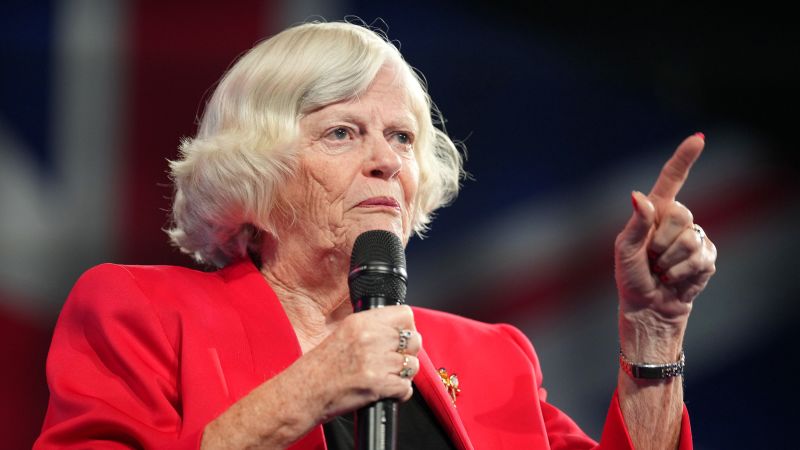
UK Counter-Terror Police Lead Investigation into Suspected Murder of Former MP Ann Widdecombe
Qwenews.com – The UK counter-terror police are at the forefront of the investigation into the suspected murder of Ann Widdecombe, a former Conservative MP and government minister. Devon and Cornwall Police have partnered with Counter Terrorism Policing North East and South Yorkshire Police to coordinate the inquiry, which has raised questions about the potential political or terrorist motives behind the crime. Home Secretary Shabana Mahmood confirmed that the suspect’s actions may be tied to a broader ideological agenda, underscoring the significance of the case for national security.
Ann Widdecombe’s Political Career and Public Influence
Ann Widdecombe, who served as a Member of Parliament for 14 years, was a prominent figure in UK politics known for her sharp wit and outspoken views on immigration and social issues. After retiring from the House of Commons in 2015, she became a vocal advocate for Reform UK, a party founded by Nigel Farage to continue the Brexit movement. Her death has sent shockwaves through political circles, with many highlighting her decades-long contribution to public discourse. The UK counter-terror police leading the case suggests that her assassination may reflect a targeted attack on a political figure, raising concerns about the growing threat of extremism in British society.
Widdecombe, 78, was found dead at her home in Haytor, Devon, on Thursday, July 14. According to authorities, she likely died the previous day, with her body discovered by family members. Assistant Chief Constable Matt Longman emphasized the severity of her injuries, stating that the circumstances of her death point to a deliberate act. The police have not yet disclosed the exact time of death, but early reports suggest the attack occurred late at night, adding to the mystery surrounding the incident.
Arrest of the Suspect and Ongoing Police Efforts
A 28-year-old man from South Yorkshire was arrested on Saturday, July 15, under suspicion of murder. The suspect, a white British national, is currently in custody and being questioned by investigators. Devon and Cornwall Police have stated that the collaboration with Counter Terrorism Policing North East and South Yorkshire Police was crucial in identifying and apprehending the individual. This marks the first major case involving the UK counter-terror police leading an investigation into a high-profile political figure, highlighting the agencies’ expanded role in addressing threats beyond traditional security concerns.
While the suspect’s identity has been revealed, the motive behind the attack remains under scrutiny. Investigators are examining whether the crime was linked to a specific ideological stance or a personal vendetta. The UK counter-terror police leading the inquiry has prompted discussions about the potential for politically motivated violence, particularly in light of recent tensions surrounding immigration and national identity. The police are also reviewing surveillance footage and witness statements to build a comprehensive case against the suspect.
Political Reactions and Public Sentiment
Following the news of Widdecombe’s death, political leaders and commentators have expressed widespread grief and solidarity. Nigel Farage, her former party leader, called her a “tireless advocate for the people” and praised her unwavering commitment to the Brexit cause. Meanwhile, Prime Minister Keir Starmer described her passing as a “devastating loss for the nation,” emphasizing her role as a unifying voice in a divided political landscape. The UK counter-terror police leading the investigation has further intensified the focus on the intersection of politics and security, with experts warning of the increasing risks posed by radicalization.
Members of the public have also voiced their support for Widdecombe, with many sharing tributes on social media and in local newspapers. Her death has sparked debates about the safety of political figures in the UK and the need for stronger protective measures. The police have assured the public that the UK counter-terror police leading the inquiry is working diligently to uncover the truth and bring the perpetrator to justice. As the investigation continues, further details are expected to shed light on the broader implications of the case for British politics and counter-terrorism strategies.
With the UK counter-terror police leading the charge, this case has taken on national significance. The suspect’s background is being closely examined, including any potential connections to extremist groups or ideological movements. Investigators are also exploring whether the attack was part of a larger pattern of targeted violence against political leaders. The police have requested additional resources to expedite the inquiry, which is now a priority for the Home Office. As the case unfolds, it is likely to influence public perception of the UK’s counter-terrorism capabilities and the security challenges facing its political institutions.