
It was supposed to be Trump’s big legislative achievement. It could be a weapon for Democrats to win in the midterms
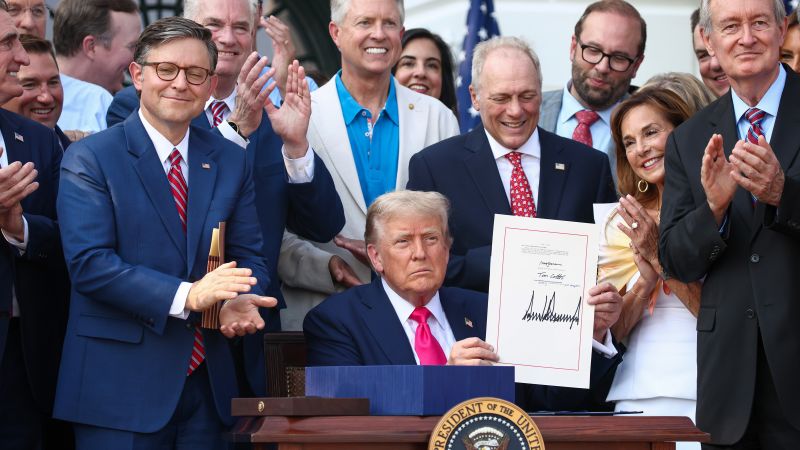
Qwenews.com – As the nation celebrated its 250th birthday on July Fourth, President Donald Trump highlighted a thriving stock market, called for electoral reforms, and praised military actions in Venezuela and Iran. Yet, one milestone remained unacknowledged: the enactment of the One Big Beautiful Bill Act (OBBBA), which Trump signed into law exactly one year prior. At the time, the bill was seen as a pivotal moment for Republicans, offering a platform to rally voters around its promises of tax cuts and economic growth. However, a year later, the law’s provisions cutting federal spending on safety-net programs like Medicaid and food stamps have turned into a point of contention, casting doubt on its political viability.
Democrats have leveraged the growing backlash against the act, emphasizing its negative effects on vulnerable populations. The legislation’s most contentious element—reductions to Medicaid funding—has become a focal point in key races, particularly in battleground districts where healthcare access is a top priority. While the Trump administration framed the law as a “Working Families Tax Cut Bill,” critics argue its impact on lower-income Americans is more damaging than beneficial. The Congressional Budget Office estimates the OBBBA will cut approximately $1.2 trillion from Medicaid over the next decade, potentially leaving 7.5 million more people uninsured by 2034.
Medicaid Reforms Spark Political Firestorm
Among the law’s most politically volatile provisions is the introduction of a federal work requirement for Medicaid recipients. This policy, a long-standing Republican objective, has drawn sharp criticism from Democrats, who highlight its potential to disrupt healthcare for those who rely on it most. In California’s 22nd Congressional District, for instance, Democrat Randy Villegas has made the Medicaid cuts central to his campaign against GOP incumbent David Valadao. “We’re the most impacted in the entire country, where two out of every three constituents depend on Medicaid,” Villegas stated to CNN. “Almost 70,000 people could lose access to healthcare in our district.”
“I represent one of the top targeted districts in the entire country, and it’s on me to go out and sell the merits of this,” said Rep. Tom Barrett, a Republican running for reelection in Michigan’s 7th District.
Valadao, meanwhile, has defended the law, asserting that it will safeguard Medicaid for essential groups such as seniors and children with disabilities. “My goal in representing the Central Valley is to protect Medicaid for those who need it the most,” he told CNN in a recent statement. In Iowa’s Senate race, Democrat Josh Turek has also targeted Republican Ashley Hinson, citing the bill’s strain on healthcare providers. Turek, who uses a wheelchair due to spina bifida linked to his father’s Agent Orange exposure, personally connects the reforms to his own healthcare challenges. “I know firsthand the importance of access to quality care,” he noted.
The OBBBA includes a $50 billion Rural Health Transformation Program, aimed at addressing concerns about the impact on remote communities. While this initiative is presented as a compromise, experts argue it falls short of compensating for the projected $137 billion in Medicaid funding losses in rural areas over a decade. For example, Iowa is expected to lose more than $3.8 billion in federal support during that period. Republican allies have emphasized this program to voters, with ads from the National Republican Senatorial Committee noting its allocation of over $209 million for rural healthcare in the state.
With the midterms approaching, the law’s legacy is uncertain. Its provisions have shifted from a Republican triumph to a potential liability, influencing how candidates frame their platforms and shaping the outcome of key races. As the political landscape evolves, the OBBBA stands as a reminder of how policy decisions can redefine electoral strategies in unexpected ways.