
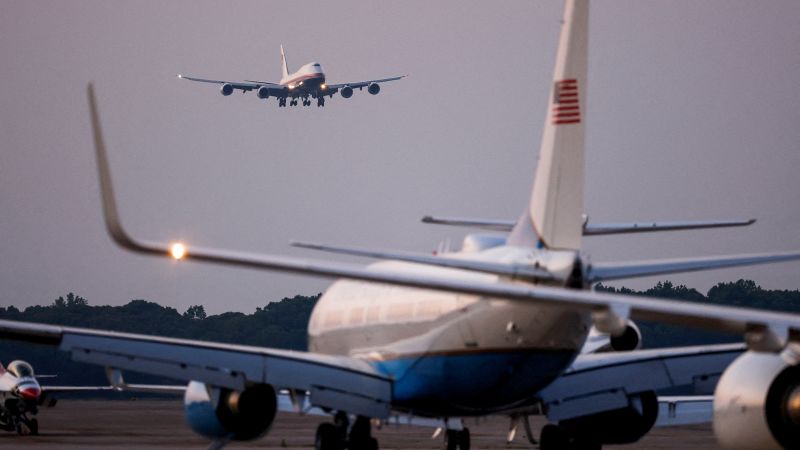
The Newest Air Force One is in Flight, but Is It Ready for Threats?
Qwenews.com – President Donald Trump recently boarded a 35-year-old modified Boeing 747 for a high-profile trip, raising questions about the readiness of the newly converted Air Force One. The Qatari-funded aircraft, which was unveiled just days earlier, has sparked debate over its ability to withstand potential threats in high-risk environments. While the newer model is designed to enhance presidential security, the decision to use the older plane has left some to wonder whether the upgrades were sufficient for modern challenges.
Accelerated Development and Key Features
The newest Air Force One, a Boeing 747-8, was rushed into service after a year of modifications. Its unveiling in early July marked the culmination of a complex conversion process involving advanced technology and design changes. The aircraft features a modernized cockpit, improved communication systems, and enhanced command capabilities, all aimed at supporting the president’s needs in a rapidly evolving geopolitical landscape. However, the timeline for its development has led to concerns about whether all critical security measures were integrated.
Despite its sleek new exterior, the newest Air Force One lacks certain visible upgrades compared to its predecessors. Aviation experts noted the absence of tail cone alterations typically used for missile defense systems, though this doesn’t necessarily indicate a lack of underlying technology. The older fleet, for instance, is known to carry chaff and other countermeasures to neutralize guided threats, which are now a primary focus of modern security protocols.
Security Assessments and Expert Concerns
During the July 17 unveiling, Trump emphasized the plane’s cutting-edge design, claiming it was “never been built before.” Yet, some analysts questioned whether the accelerated schedule compromised its protective capabilities. Frank Kendall, a former Air Force secretary, explained that the conversion prioritized essential systems over cosmetic changes. “They had to leave out many features of a standard Air Force One to meet the deadline,” he stated, highlighting the trade-offs made during the development phase.
“You have to basically do structural changes to put the antennas in. Some of that, I’m sure they did. I’m not sure how much,” Kendall added, underscoring the balance between innovation and practicality.
The newest Air Force One is expected to handle a range of threats, including nuclear attacks and electromagnetic pulses. These challenges were central to Cold War-era aircraft designs, and the modernized version incorporates updated systems to address them. However, the absence of certain visible modifications, like the tail cone enhancements, has led to speculation about its full readiness. While the White House maintains that all critical upgrades were included, details remain classified, leaving room for continued scrutiny.
As the newest Air Force One continues its operational debut, its effectiveness will be closely monitored. The recent use of the older model, especially during military actions against Iran, has provided a real-world test of its preparedness. With its modern features and upgraded systems, the newest Air Force One is a significant step forward, but whether it can fully protect the president in all scenarios remains a topic of discussion among security experts and policymakers alike.