
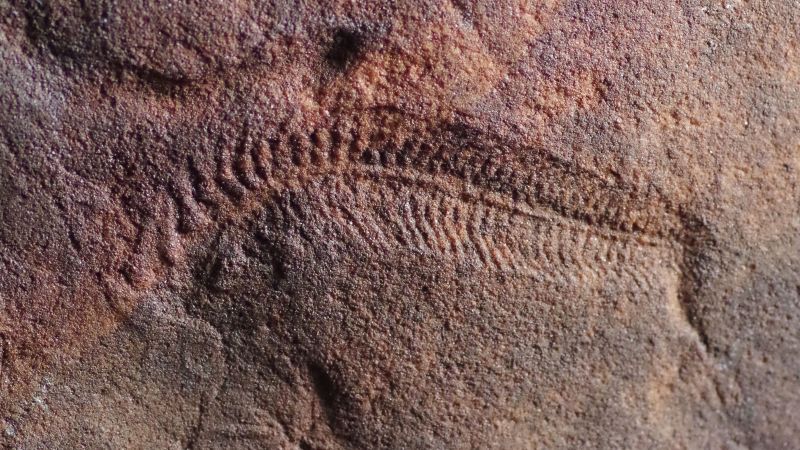
Fossils reveal the earliest animal with a head was also the oldest known ‘righty’
The Discovery of Right-Handed Movement in Spriggina Floundersi
Qwenews.com – Fossils reveal the earliest animal — a groundbreaking discovery that has reshaped our understanding of ancient life — is also the oldest known example of directional handedness. Researchers analyzing a worm-like creature from 550 million years ago, Spriggina floundersi, found compelling evidence that it exhibited a preference for right-handed movement. This finding, published in Scientific Reports, challenges long-held assumptions about the origins of directional bias in animals. The fossilized remains, unearthed in South Australia, not only confirm that Spriggina floundersi was the earliest known animal with a head but also suggest that its behavior included a trait now observed in modern species like humans, primates, and insects.
The study of these fossils has been pivotal in uncovering the evolutionary roots of handedness. Spriggina floundersi thrived during the Ediacaran Period (635 to 542 million years ago), an era when the first complex animal life began to emerge. Its flattened, segmented body, with an oval shape and a distinct, curved structure at one end, marks it as the earliest known animal with a head. First identified in 1958, this creature has been the subject of debate regarding its ability to move independently. However, recent analysis provides definitive evidence that Spriggina was capable of independent locomotion, a critical step in the development of directional behavior in early animals.
Analysis of Fossil Curvature and Movement Patterns
Scientists conducted the most comprehensive study of Spriggina fossils to date, examining over 100 specimens from various sites. Their findings indicate that the creatures could wriggle across the seafloor, with the majority of fossils showing a consistent leftward curvature. This suggests that Spriggina floundersi had a natural inclination to bend in one direction, a trait that aligns with modern right-handedness. “About twice as many of these things are bent to the left as are bent to the right,” noted Scott Evans, lead author of the study, highlighting the significance of this asymmetry.
“Fossils of early animals, to most people — even to me — they look weird,” said Evans, an assistant curator at the American Museum of Natural History and a professor at its Richard Gilder Graduate School. “But if you push past that weirdness, what we see is that a lot of the fundamental characters we associate with animals today, like movement and handedness, are already present.”
The analysis of body curvature and orientation in the rock layers provided critical insights into the creature’s behavior. While some fossils displayed straight bodies, the majority exhibited a consistent leftward bend, implying that the animals naturally curved to the right. To validate this, the research team examined sedimentary patterns surrounding the fossils, ruling out the possibility that currents or storms had distorted their shape. This meticulous approach ensured the accuracy of their conclusions about Spriggina’s movement tendencies.
Implications for Evolutionary Development
The implications of this discovery extend beyond the physical traits of Spriggina floundersi and into the broader realm of evolutionary development. The presence of directional handedness in such an ancient species suggests that the neurological and muscular mechanisms enabling this behavior were already in place millions of years before the rise of more complex animals. Diego García-Bellido, a paleontology expert at Adelaide University, praised the study’s rigor, stating that the researchers “have clearly considered and stated all alternative hypotheses, offering clear and valid arguments for their interpretations.”
This breakthrough implies that Spriggina floundersi possessed a nervous system capable of directing muscle movement. Such a system would have allowed the creatures to navigate their environment with purpose, a key evolutionary step toward directional preference. The study’s findings add to the growing body of evidence that early animals had more advanced capabilities than previously thought, bridging the gap between simple invertebrates and the complex behaviors seen in modern species. As the earliest animal with a head and the oldest known ‘righty,’ Spriggina floundersi serves as a critical link in understanding the development of behavioral traits over geological time.
Though no living species matches Spriggina floundersi exactly, its traits laid the groundwork for behaviors observed in today’s animals. The creature, which could grow up to 4 inches (10 centimeters) in length, had a range of sizes from 0.8 to 1.2 inches (2 to 3 centimeters). Its ability to bend in both directions, including forming a U-shape, further supports the idea of active movement rather than passive environmental influence. This flexibility in body orientation adds another layer to the complexity of Spriggina’s locomotion, reinforcing its role as a pioneer in the evolution of directional behavior.