
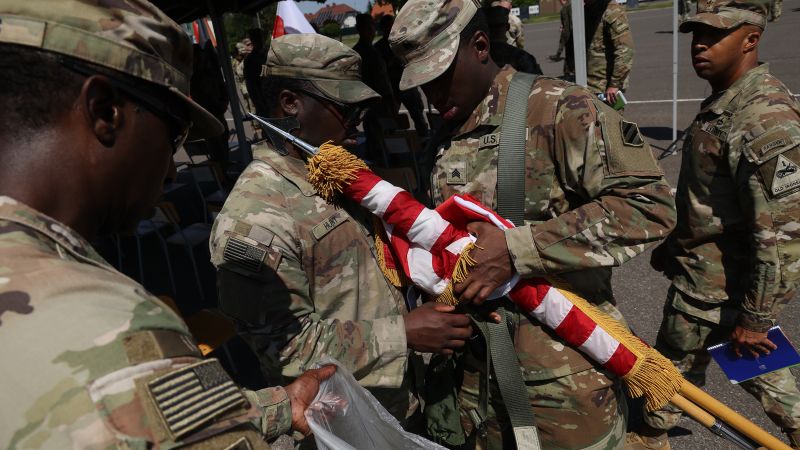
Trump Mused About Cutting Troops in Europe to Pressure NATO Allies
Qwenews.com – During a White House meeting in early spring 2026, President Donald Trump reportedly considered reducing the number of U.S. troops stationed in Europe by a third. This idea, shared by two informed sources, emerged as a strategic move to challenge NATO members over their perceived lack of commitment to collective defense. Trump emphasized the need for European allies to shoulder more responsibility, suggesting the troop cut would serve as a bold statement to push for greater financial and military contributions.
Strategic Shift in Military Presence
The proposal to trim European troop numbers sparked immediate reactions within the Pentagon. Defense Secretary Pete Hegseth initially aimed to announce sweeping reductions at a June NATO summit, potentially aligning with Trump’s suggested one-third cut. However, after consultations with senior officials, the plan evolved into a six-month review of U.S. military deployment in the region. Hegseth warned that some NATO countries might struggle to meet their obligations, while others would demonstrate stronger resolve. This evaluation period reflects a broader effort to reassess the U.S. military footprint in Europe and its alignment with current strategic priorities.
Trump’s focus on troop reductions is tied to his frustration with NATO’s slow response to U.S. military initiatives. During the Iran conflict, he argued that European allies had not provided the necessary support, which he saw as a failure of the alliance to reciprocate American efforts. The president’s dissatisfaction is part of a larger pattern of questioning NATO’s value, particularly as he aims to reallocate resources to other global theaters. His remarks underscore a potential shift in U.S. defense strategy, emphasizing flexibility over fixed commitments.
Implications for NATO’s Defense Posture
The potential reduction of U.S. troops in Europe could significantly impact NATO’s ability to maintain a rapid response capability. With the U.S. currently hosting over 300,000 troops in the region, a one-third cut would reduce this number by approximately 100,000. While the Pentagon has not finalized the plan, the idea highlights a growing concern among military analysts that such a move might weaken NATO’s deterrence in the face of rising threats from Russia and Iran. European officials have expressed apprehension, fearing that the cut could lead to a breakdown in alliance cohesion.
Trump’s proposal has also raised questions about the strategic rationale behind maintaining a large U.S. military presence in Europe. Critics argue that the move could embolden adversaries, while supporters contend that it would force NATO members to take more accountability. The president’s approach, characterized by direct pressure and a willingness to renegotiate commitments, has drawn mixed reactions from allies. Some see it as a necessary measure to modernize the alliance, while others worry it could undermine decades of cooperation.
As the NATO summit in Ankara approaches, Trump’s musing about cutting troops in Europe by a third has added another layer of complexity to the discussions. The summit, held in Turkey, brings together leaders from across the alliance to address shared security concerns. Trump’s presence has been met with both support and skepticism, as European officials seek to balance his demands with the need for stability in the region. The outcome of the summit may determine whether the U.S. troop cut becomes a reality or remains a symbolic gesture.
Trump’s public praise for Turkish President Recep Tayyip Erdoğan contrasts with his private frustrations over the lack of NATO solidarity. His ambassador to the alliance, Matthew Whitaker, noted that the summit aimed to showcase allies’ resolve, and Trump expects tangible steps to address his concerns. Meanwhile, his ongoing feud with Italian Prime Minister Giorgia Meloni highlights the challenges of maintaining unity within NATO. The president’s repeated emphasis on troop cuts and financial obligations has intensified the debate over the alliance’s future direction, with European leaders working to prevent a major rift.