
The new tastemakers are cutlery designers
Qwenews.com – Dung Ngo, a design writer and collector, has accumulated more than 10,000 pieces of cutlery over the years. His journey began 25 years ago, when he realized that the utensils he bought from Target after college no longer matched his evolving sense of self. A key moment came when he stumbled upon a 40-piece set in a vintage shop for $400, which he recognized as Composition by the Finnish designer Tapio Wirkkala. Today, a complete Wirkkala collection can command prices exceeding $3,600.
From Obsession to Book and Exhibition
Ngo’s fascination with cutlery led to the publication of his new book, “Knife Fork Spoon: Modernist Cutlery 1900–2025,” launching in August. The 600-page survey of iconic flatware is accompanied by an exhibition at the Denver Art Museum, showcasing over 150 designs arranged chronologically under themes like airlines, children, and travel. While the projects chart 125 years of flatware evolution, Ngo felt the narrative was incomplete. “There is also a future to this category, and maybe I can actually participate in that future in a real, physical way, rather than just writing about it,” he said.
“I became hooked. Cutlery is among the most intimate objects in daily life.”
His research uncovered a structural issue: modern cutlery has remained largely unchanged for 150 years. “We start the production with a flat sheet of metal, and then you bend it,” he explained. “It can get quite three-dimensional, but never highly sculptural.” Additionally, the craft behind traditional production is fading. In Solingen, a historic German hub for cutlery makers, Ngo found only a few manufacturers still active. A similar trend was observed in Sheffield, England, where the workshop of influential designer David Mellor, dubbed the “Steel City” for its industrial legacy, revealed a similar decline. “It’s nearly all gone,” Ngo reflected. “That was heartbreaking.”
Reviving the Future of Cutlery
Looking toward the future, Ngo drew inspiration from a 3D-printed metal set by architect Greg Lynn for Alessi in 2007. The design, an experimental piece costing $10,000 to $20,000 per set, was initially produced in limited numbers. “I called Greg and said, ‘Can I take your design and put it back into production?’ He said, ‘Absolutely. Now is the time – twenty years later is perfect,’” Ngo recounted.
“He explained that in Nigeria, when you go out to eat, you’re asked if you want to eat with a fork and a spoon, or with your hands, which is the traditional way. If you say hands, you’re brought a bowl of water to clean your hands, which is part of the ritual of dining.”
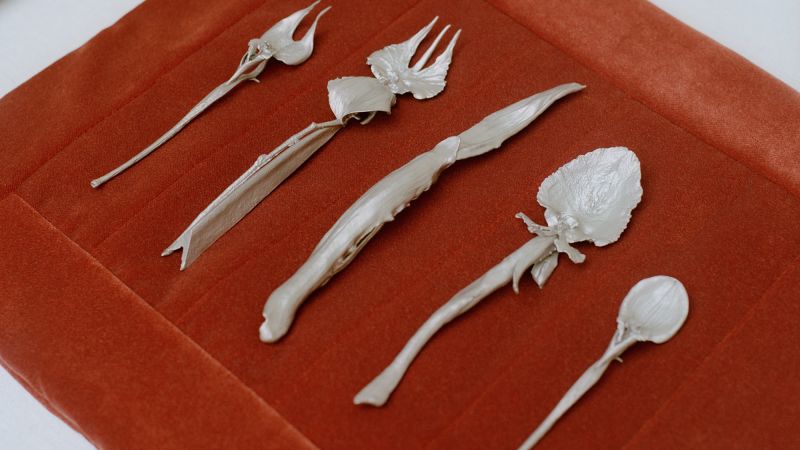
To reimagine cutlery for the future, Ngo invited eleven international artists to contribute. The guidelines emphasized personal expression, cultural relevance, and the use of 3D printing on sintered steel. Function was secondary, as he noted, “You can buy that stuff from anywhere for fifty bucks.” The result was the “Knife, Fork, Spoon 3.0” exhibition, co-curated by Ngo and presented by the Los Angeles gallery Marta at 3 Days of Design in Copenhagen. The event highlighted diverse approaches, such as Minjae Kim’s Korean set with chopsticks and Nifemi Marcus-Bello’s Nigerian designs featuring a resin bowl. Ngo singled out Marcin Rusak’s Polish set, which connected to his grandfather’s legacy as a nationally renowned orchid breeder. “Growing up, my grandfather was a nationally famous orchid breeder. In some ways, orchids are my first learned visual language,” Rusak shared.