
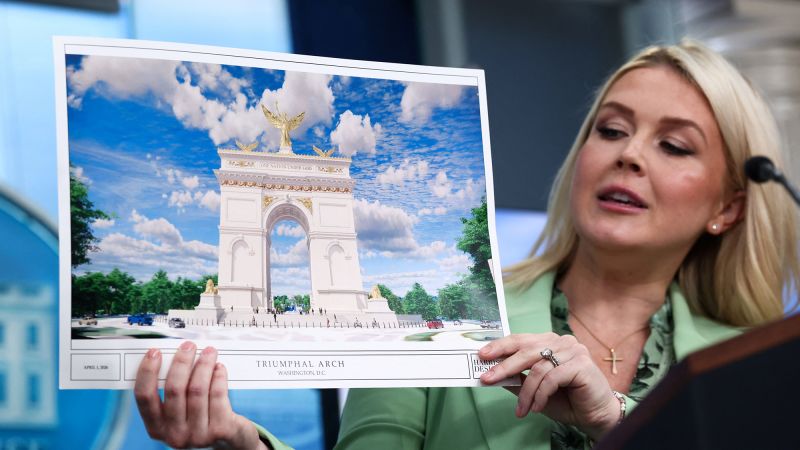
FAA Says Trump’s Proposed 250-Foot Triumphal Arch Poses No Aviation Risk
Qwenews.com – President Donald Trump’s proposed 250-foot triumphal arch near Ronald Reagan Washington National Airport has been evaluated by the Federal Aviation Administration (FAA), which concluded that the structure would not significantly endanger air traffic. The agency’s findings, released recently, indicate that the arch is unlikely to interfere with existing flight paths or navigational procedures, though it suggested adding red obstruction lights for added visibility. This assessment comes as the arch remains a focal point of political and public debate, with critics arguing over its potential impact on aviation safety.
Arch Design and Location Considerations
The proposed triumphal arch, designed as a symbolic monument, would be situated at the end of Memorial Bridge, facing the iconic Lincoln Memorial. While its base is planned to be 250 feet tall, the National Parks Service noted that when combined with the elevation of the site, the total height would reach 279 feet. This detail is crucial, as FAA regulations require structures exceeding 200 feet in height to be scrutinized for potential aviation hazards. The agency’s report emphasizes that the arch’s placement and design mitigate risks to air traffic operations.
“The FAA’s analysis found that the arch would have ‘no significant adverse effect on airspace and visual/instrument procedures’ at Reagan National,” the agency stated in its report.
The assessment considered factors such as the angle of approach for aircraft, visibility conditions, and the proximity of other landmarks like the Pentagon and Washington Monument. These structures already present challenges for pilots navigating the northern approach corridor, but the arch’s height and location were deemed compatible with current aviation standards.
FAA’s Evaluation Methodology
The FAA conducted a limited review of the arch’s potential impact, highlighting that a full aeronautical study would be required before final approval. This process typically takes nine months, but the agency acknowledged that its current assessment could be completed within 45 to 90 days. The expedited timeline reflects the administration’s urgency in advancing the project, which is seen as part of broader efforts to create lasting monuments in Washington, D.C.
The report noted that the arch’s design aligns with existing air traffic patterns, reducing the likelihood of collisions or navigation disruptions. However, the FAA acknowledged that further studies might be needed if the structure’s presence alters traffic flow in unexpected ways. This finding has sparked discussions among aviation experts about the balance between historical symbolism and safety regulations in urban settings.
Historical Context and Aviation Incidents
The northern approach corridor, where the arch is proposed, has a history of aviation challenges. Notable incidents include a midair collision between an American Airlines flight and a Black Hawk helicopter in 2023, as well as a 1982 crash into the 14th Street Bridge during takeoff. These events have made the area a point of interest for safety advocates, who now await the FAA’s final determination on Trump’s 250-foot triumphal arch.
While the FAA’s report downplays the arch’s risks, some pilots and aviation experts remain cautious. They argue that even minor obstructions can compound existing difficulties in the corridor, particularly during high-traffic periods or adverse weather conditions. The agency’s recommendation for red obstruction lights is seen as a pragmatic step to enhance visibility without compromising the arch’s aesthetic or symbolic purpose.
Political and Regulatory Pathways
The approval process for the arch involves multiple federal agencies, including the Commission of Fine Arts and the National Capital Planning Commission. These bodies are responsible for ensuring that monuments and infrastructure in the nation’s capital meet aesthetic, functional, and safety criteria. Earlier this week, the National Capital Planning Commission gave its endorsement, but final decisions will depend on the Trump-aligned panels that oversee the project.
Political considerations have played a significant role in the arch’s development, much like other controversial projects such as the White House ballroom expansion and the Kennedy Center renaming initiative. Critics suggest that the expedited approval may prioritize symbolic representation over thorough safety evaluations, while supporters argue that the structure enhances the city’s cultural landscape without jeopardizing air travel. The FAA’s findings provide a critical but not conclusive basis for the decision, leaving room for further debate and analysis.
CNN’s Sunlen Serfaty contributed to this report.