
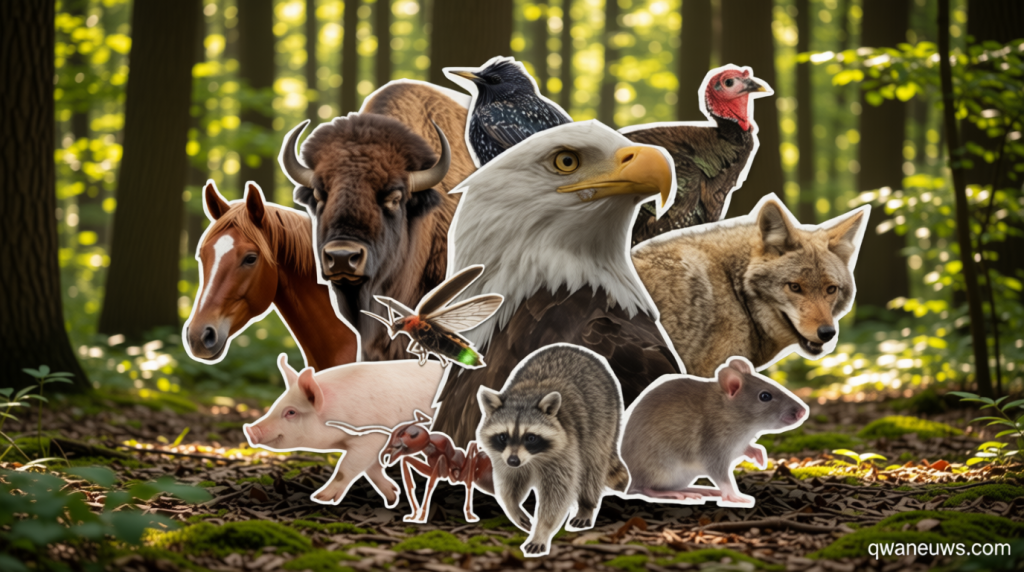
What is the Most American Animal? A Symbol of National Identity and Resilience
Qwenews.com – The question of What is the most American animal? has sparked debates for centuries, with the bald eagle standing as the nation’s most iconic representation. In 1782, Charles Thomson, a lesser-known Founding Father, proposed the eagle as the Great Seal of the United States. This design depicted the bird holding arrows and olive branches, symbolizing both strength and peace. While Benjamin Franklin famously advocated for the turkey as a more fitting national symbol, the eagle’s adoption solidified its place in American culture as a powerful emblem of the country’s founding principles.
The Bald Eagle’s Historical and Cultural Significance
The bald eagle’s selection as a national symbol was not just a matter of aesthetics. It reflected the ideals of independence and perseverance that defined the early United States. By the time the seal was finalized, the eagle had already been celebrated in American folklore for its majesty and strength. However, its symbolic status also meant it became a target for critique. As Janet M. Davis, a professor of American studies at the University of Texas at Austin, observed, “When animals become symbols, they often cease being animals. Instead, they become ideological repositories,” embodying abstract values like freedom and resilience.
Despite its symbolic grandeur, the bald eagle’s ecological role is equally important. Native to North America, this bird thrives in a variety of habitats, from coastal areas to inland forests. Its diet includes fish, small mammals, and even other birds, making it a versatile predator. Yet, its survival has not always been guaranteed. By the mid-20th century, the species faced near extinction due to human activity, habitat destruction, and the widespread use of DDT. This decline sparked conservation efforts that ultimately led to its recovery, cementing its status as a success story in environmental protection.
From Decline to Revival: The Eagle’s Conservation Journey
Historians note that the bald eagle’s symbolic stature often overshadowed its ecological challenges. During the Civil War, for instance, the 8th Wisconsin Volunteer Infantry Regiment carried a live eagle named Old Abe as a mascot, symbolizing courage and unity. However, this same bird was also blamed for stealing livestock and attacking human infants, leading to its vilification in some communities. By the early 1900s, these perceptions had fueled a decline in its population, with estimates suggesting fewer than 500 nesting pairs remained by the 1960s.
That turning point came with the passage of the Endangered Species Act in 1973, which provided critical legal protections for the bald eagle. Conservationists worked tirelessly to restore its habitat and eliminate threats like DDT, which had caused eggshell thinning and reproductive failure. Today, the species has rebounded to over 300,000 nesting pairs, a testament to the power of collective action. As the Department of the Interior stated, “The soaring bald eagle stands as a living monument to American resilience, stewardship, and the power of conservation.” This revival has further reinforced its role as a national symbol, even as its natural behaviors remain misunderstood by many.
While the bald eagle is undeniably the most prominent symbol, some argue that its status as What is the most American animal? is not universal. The United States is home to a vast array of wildlife, from the humble prairie dog to the majestic grizzly bear. Each species represents different aspects of the nation’s geography and culture. However, the eagle’s ability to adapt to human presence and its enduring image in popular media have kept it at the forefront of national identity. Its return from the brink of extinction is often cited as a metaphor for American perseverance, even in the face of adversity.
Challenges to the Eagle’s Symbolism
Some experts question whether the bald eagle truly represents the diversity of American life. Ecologists highlight that the bird’s habitat is limited to specific regions, unlike the widespread presence of species like the raccoon or the coyote. These animals, while less iconic, are more integrated into the daily routines of Americans across the country. Yet, the eagle’s symbolism persists, largely due to its historical narrative and the emotional resonance it carries.
For example, the eagle’s image appears on everything from currency to official documents, making it instantly recognizable. This ubiquity has created a cultural shorthand for American values, even as the bird itself is often seen as a solitary, powerful figure. Jack E. Davis, a Pulitzer Prize-winning author and environmental historian, remarked, “Yes, it’s a scavenger and fish robber, but we aren’t perfect ourselves. And what does the bald eagle say about 2026: It’s proven to be a survivor, and so have we — so far.” This quote underscores the tension between the eagle’s natural traits and its symbolic role.
The debate over What is the most American animal? is not just academic. It reflects broader conversations about how Americans define their identity. While the eagle is a unifying symbol, other animals like the cow, the eagle, or the horse have also played significant roles in shaping the nation’s image. The cow, for instance, represents the agricultural heartland, while the horse symbolizes frontier spirit. However, the eagle’s combination of grace, strength, and adaptability continues to make it the most enduring choice.