
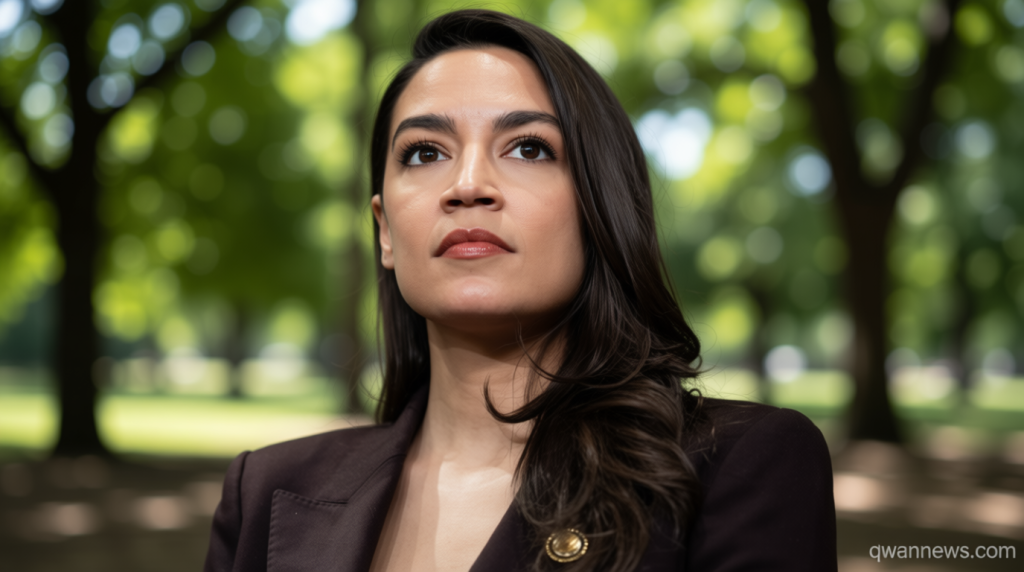
Vance Says He Believes AOC Will Lead Democratic Field in 2028
Qwenews.com – JD Vance, the current vice president, has made a bold prediction during a recent interview, stating that he believes Alexandria Ocasio-Cortez will be the Democratic Party’s leading candidate in the 2028 presidential election. This assertion has sparked renewed discussions about the evolving political landscape and the potential influence of progressive figures within the party. Vance’s remarks came amid a growing divide between centrist and radical factions, positioning AOC as a central figure in shaping the Democratic narrative moving forward.
Vance’s Critique of Newsom
Vance recently addressed California Governor Gavin Newsom’s standing in the Democratic race, dismissing the idea that Newsom would be the party’s frontrunner. “No, no,” he said, emphasizing that Newsom’s recent comments had weakened his position. During a book event in Atlanta, Newsom had humorously remarked that he felt “low IQ” when compared to an audience of Black Americans, a remark Vance took as evidence of Newsom’s disconnect from key Democratic demographics. “I think he hurt himself,” Vance added, highlighting the governor’s perceived insensitivity.
“I’m not trying to impress you. I’m just trying to impress upon you. I’m like you. I’m no better than you, you know, I’m a 960 SAT guy … you’ve never seen me read a speech, because I can’t read a speech.”
This exchange underscored Vance’s argument that the Democratic Party’s leadership is increasingly fragmented, with figures like Newsom struggling to maintain credibility among voters who prioritize authenticity and relatability. By contrasting Newsom’s academic background with his unpreparedness for public speaking, Vance aimed to illustrate a broader theme: the party’s future may depend on its ability to bridge ideological gaps and resonate with a diverse electorate.
AOC’s Potential Role in the 2028 Race
Alexandria Ocasio-Cortez, the progressive firebrand and congresswoman from New York, has emerged as a prominent name in Democratic circles. When asked about Vance’s claim, AOC responded with a candid smile, acknowledging the possibility but stopping short of outright endorsement. “I hope he is” the nominee, she said, expressing optimism about her own viability as a candidate. Her popularity among younger voters and her strong stance on climate policy and economic reform have solidified her as a potential leader, though her path to the presidency will require navigating internal party tensions.
Vance further emphasized AOC’s unique position within the Democratic Party, suggesting that her influence stems from her alignment with the party’s left-wing base. He compared her to another potential rival, Georgia Senator Jon Ossoff, stating that the Democratic field’s direction hinges on whether the party’s power lies with “Wall Street and the left of center business community” or with “the universities.” AOC, with her academic credentials and grassroots appeal, fits squarely into the latter category, making her a compelling choice for those seeking a more radicalized platform.
While Ossoff has been vocal in his own campaign, he faces an uphill battle in securing his Senate seat for the midterms, which could impact his eligibility for the 2028 race. Vance’s argument highlights a shift within the Democratic Party, where candidates must balance economic populism with ideological clarity. AOC’s progressive policies and energetic campaign style position her as a candidate who could galvanize both the party’s base and a broader coalition of voters seeking transformative change.
Political Implications of the Prediction
Vance’s belief that AOC will be the Democratic nominee in 2028 signals a potential realignment of the party’s priorities. His comments suggest a growing concern that the Democrats may be drifting toward ideological extremes, with AOC representing the left’s most prominent voice. This could have significant implications for the party’s strategy, particularly in appealing to moderate voters and avoiding a repeat of the 2016 and 2020 election dynamics. Analysts note that AOC’s potential candidacy would further strengthen the Democrats’ position on key issues like climate change and wealth inequality, but could also deepen divisions with more centrist factions.
Meanwhile, Republican President Donald Trump has already begun positioning himself as a key player in the 2028 race, suggesting that either Vance or Secretary of State Marco Rubio might become his successor. His focus on the Democratic left reflects a strategy to frame the party as increasingly radical, with figures like Newsom and AOC serving as symbolic targets. Vance’s endorsement of AOC, though not explicit, may help solidify her standing as a unifying figure within the Democratic ranks, particularly among younger and more progressive voters.
As the 2028 presidential election approaches, the Democratic Party faces a critical juncture. With AOC’s potential candidacy, the race could become a battle not just between policy platforms, but also between the party’s traditional establishment and its more grassroots-driven wing. Vance’s assertion adds weight to this debate, suggesting that the nomination may hinge on the ability of candidates to capture the attention of a politically active and ideologically diverse electorate.