
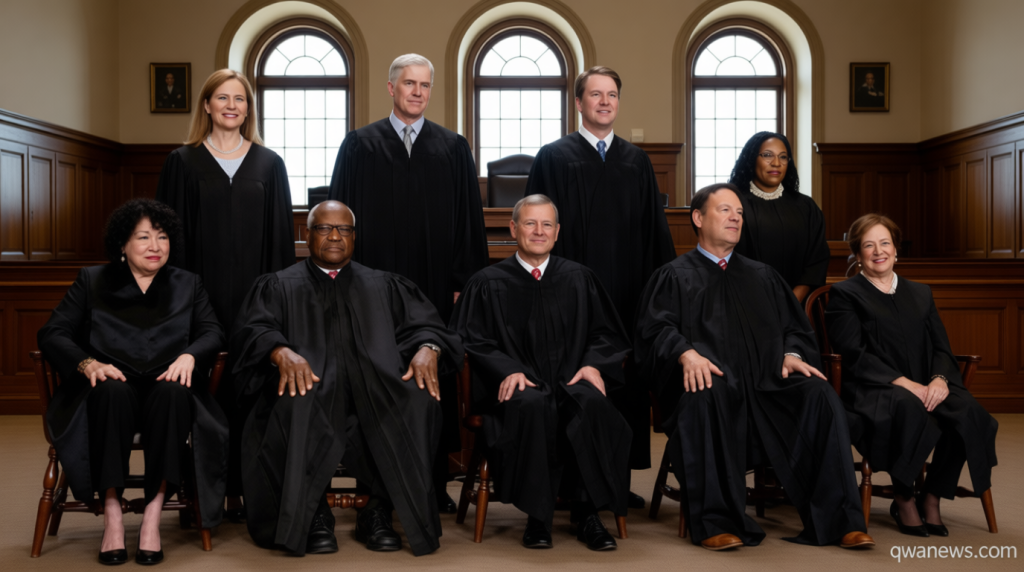
How the Supreme Court Became a Political Force Redefining America
Qwenews.com – In recent years, the Supreme Court has increasingly appeared as a central force in shaping national policy. With nine justices now regularly stepping into the spotlight, the court is tasked with resolving disputes that have become deeply polarizing, often taking on issues that other institutions have failed to address decisively. This shift has been amplified by the active involvement of Donald Trump, whose presidency has been marked by a relentless pursuit of constitutional change and a tendency to use legal battles as tools for advancing his political agenda.
Trump’s strategic use of the judiciary has transformed the court into a battleground for ideological influence. Even when he loses cases, he leverages them to reinforce his narrative, sharpening his attacks on opponents and reshaping the landscape of American governance. From social policies to electoral rules, the court’s decisions under his watch have the potential to redefine the nation’s character, particularly in areas like transgender rights and citizenship criteria.
A Court as a Political Actor
For many, the court’s decisive role in America’s most contentious debates has made it seem like an independent governing body. Chief Justice John Roberts, however, has consistently emphasized that the court’s function is to interpret the law, not to wield power directly. “It simply calls legal and constitutional balls and strikes,” he said, a sentiment that contrasts sharply with the court’s current visibility in the political arena.
“It simply calls legal and constitutional balls and strikes.”
As the second term of Trump progressed, the court found itself in particularly volatile territory. Its rulings often reflect a deepening partisan divide, even if the justices themselves argue that decisions are not always split along ideological lines. The public’s perception, however, is shaped by the internal tensions between justices, such as the recent exchange between Samuel Alito and Sonia Sotomayor, which has fueled the idea of the court as an ideological arena.
Historical Precedents of Judicial Influence
The court’s entanglement in politics is not unprecedented. Throughout history, it has played pivotal roles in shaping major societal shifts. During the era of slavery, its decisions were instrumental in defining the nation’s legal framework. Similarly, in the 1930s, it faced intense scrutiny as it challenged President Franklin Roosevelt’s New Deal programs. These moments highlight the court’s long-standing ability to influence the balance of power.
Even in more recent decades, the court has been a catalyst for change. Under Barack Obama, its legalization of same-sex marriage signaled a more progressive era. Yet, the overturning of the abortion right in 2022 delivered a significant conservative triumph, aligning with the goals of the evangelical movement and the broader conservative legal agenda.
Trump’s Executive Power Vision
One key reason the court is seen as a political ally to Trump lies in its expansion of executive authority. Justice Roberts’ background as a Reagan White House staffer underscores his familiarity with the theory of the unitary executive—a concept that envisions a president with vast power. This framework reached its peak during Trump’s presidency, which sought to push the office beyond its constitutional boundaries.
A landmark 2024 decision, stemming from Trump’s criminal cases, further solidified this vision by granting former presidents broad immunity for official actions. This ruling, among others, has reinforced Trump’s belief in the limitless reach of executive power. Additionally, the court’s skepticism toward corporate regulation aligns with his broader goal of dismantling policies that link wealth and political influence.
Monday’s ruling in a case related to Trump’s efforts to consolidate authority underscores a growing trend: the court is not just interpreting the law but actively redistributing power across the political system. As it continues to shape the nation’s legal and social foundations, its role as a political force seems more pronounced than ever.