
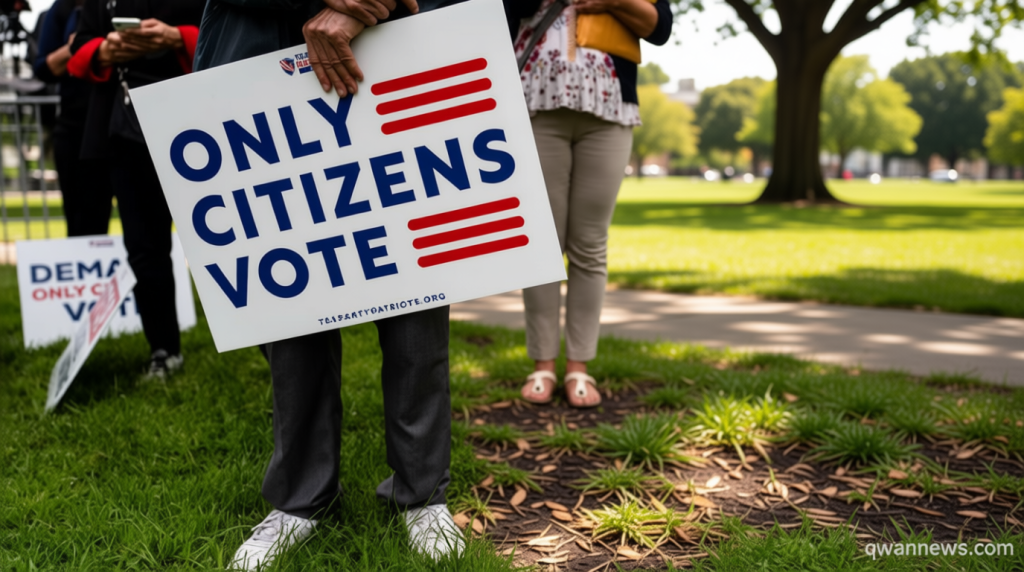
What’s in the ‘SAVE America Act’ and Why It Matters to Donald Trump
Qwenews.com – President Donald Trump has made the federal elections reform proposal, known as the ‘SAVE America Act,’ a central focus of his legislative agenda. However, the bill’s path to passage is fraught with challenges, particularly in the Senate, where Republicans face difficulties overcoming the filibuster. This tool, which allows the Democratic minority to block legislation, has already stalled the bill’s progress, but Trump’s insistence on adding contentious measures has further complicated its chances.
Key Provisions and Political Strategy
The House version of the bill, approved in February, centers on implementing rigorous voter ID and proof-of-citizenship rules. Yet, experts predict it will struggle to gain Senate approval due to the lack of bipartisan support for eliminating the filibuster. Trump, however, has amplified his push, urging Republicans to include provisions that would end no-excuse mail voting and target transgender policies—a move critics argue is more about advancing cultural issues than improving election integrity.
“The extra step of presenting documents in person would not burden most voters,” said Jason Snead, leader of the Honest Elections Project, a group backing the legislation.
These added provisions are designed to reshape voting access, with Trump emphasizing their importance for ensuring election fairness. If enacted, they could significantly alter the landscape of this year’s midterms, potentially disenfranchising millions of voters. A last-minute amendment in the House expedited some requirements, making them effective immediately rather than next year, as previously outlined.
Voter Fraud and the Push for Proof of Citizenship
Proponents of the bill argue that documented cases of voter fraud—especially by non-citizens—are rare. The Heritage Foundation’s database, for instance, lists fewer than 100 instances of such fraud between 2000 and 2025. Despite this, the legislation mandates that individuals provide proof of citizenship, such as a birth certificate, passport, or naturalization document, when registering to vote. Exceptions exist, like allowing additional documents to resolve discrepancies, such as a name change due to marriage.
According to the Brennan Center, a progressive research organization, over 21 million eligible voters lack easy access to these required documents. Supporters counter that a REAL ID, used for airport security, could suffice, though only a few states currently issue such IDs that confirm citizenship status.
Impact on Voter Registration Processes
The bill would require voters to visit their local election office in person to verify citizenship, even if they initially register online or by mail. This change could limit the efficiency of voter registration drives, which often rely on mail-in methods to reach large audiences. Snead defended the policy, noting that most voters already register in person through the DMV, but critics warn it could reduce participation among marginalized groups.
Voter ID Requirements for Federal Elections
Under the SAVE America Act, voters must present valid photo ID to cast ballots in federal elections. Acceptable forms include state driver’s licenses, US passports, and IDs for military or tribal members. However, school-issued identification cards are excluded, a detail that has drawn criticism for disproportionately affecting younger voters. Mail voters would need to submit ID copies twice—once when requesting ballots and again when returning them—though some exceptions apply.
Currently, voters simply sign an attestation under penalty of perjury to confirm their citizenship. The bill’s strict requirements aim to standardize this process nationally, but opponents claim it imposes unnecessary hurdles, particularly on those without convenient access to documentation. Whether these changes will pass remains uncertain, but their potential impact on the 2026 midterms is clear.