
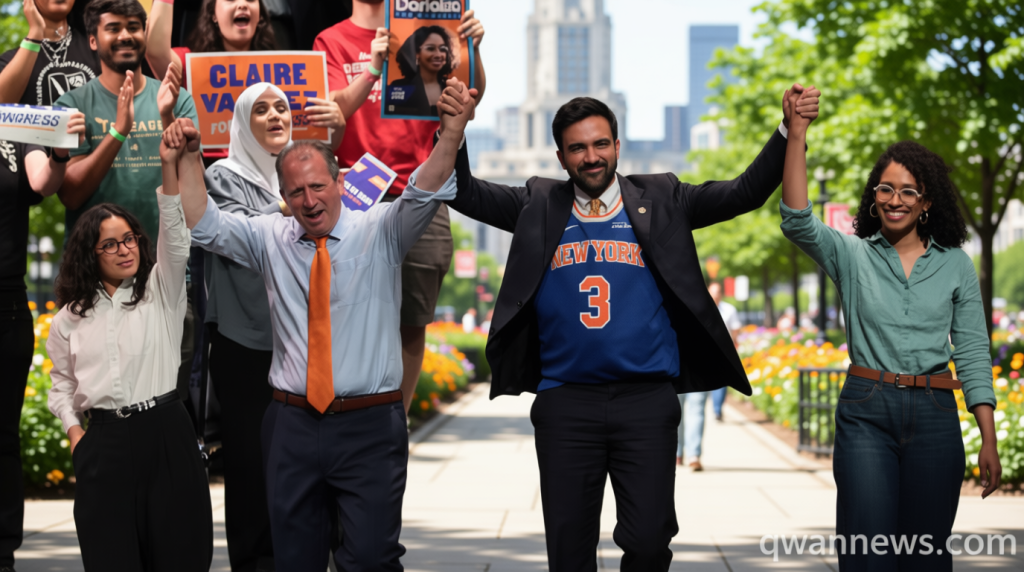
Zohran Mamdani’s Influence Over Democrats Tested in Tuesday’s Elections
Qwenews.com – Tuesday’s elections will act as a pivotal moment to assess the growing influence of Mayor Zohran Mamdani on Democratic voters, especially in key battlegrounds like New York, Maryland, and South Carolina. With six months in office, Mamdani’s ability to sway the party’s direction has become a focal point for analysts and political observers, as the results may signal whether his progressive vision can reshape the Democratic landscape ahead of the 2028 presidential race. The outcomes of these contests could also highlight the evolving dynamics within the party, where Mamdani’s faction seeks to challenge established power structures and push for a more radical agenda.
Primary Races and Mamdani’s Strategic Backing
Mamdani’s influence is evident in the primary races, where his endorsements have reshaped the competitive landscape. In New York’s 10th Congressional District, he threw his weight behind Brad Lander, a former City Comptroller who had previously lost the mayoral race to Mamdani. Lander’s campaign, supported by the mayor’s network, aims to reclaim the seat from Rep. Dan Goldman, a long-time incumbent. This move underscores Mamdani’s role in consolidating power within the Democratic Party, particularly among progressive voters. Meanwhile, in the 13th District, Mamdani’s backing of Darializa Avila Chevalier, an educator and immigrant rights advocate, has drawn both praise and criticism. Her participation in a pro-Palestinian rally following Hamas’s October 7, 2023, attack has sparked debates about her alignment with Jewish community leaders, who have questioned her ability to unify the party.
The 7th District race further illustrates Mamdani’s influence. There, he has positioned Assemblywoman Claire Valdez as a strong contender against Brooklyn Borough President Antonio Reynoso, Velázquez’s former successor. This contest is not just about the district’s future but also about the mayor’s capacity to assert his leadership in shaping the party’s priorities. His support for Valdez reflects a broader strategy to align Democratic candidates with his progressive platform, even as traditional factions resist his push for more radical policies.
Broader Implications for the Democratic Party
The races in New York are part of a larger trend of ideological shifts within the Democratic Party. Mamdani’s faction, often associated with the party’s more left-leaning elements, is pushing for policies that prioritize social justice, climate action, and immigrant rights. This strategy has gained traction in states like Washington, D.C., and Los Angeles, where similar movements are challenging mayoral incumbents. In D.C., City Councilwoman Janeese Lewis George is expected to face a major test, while in Los Angeles, Nithya Raman is emerging as a potential rival to the current mayor. These developments suggest that Mamdani’s influence may extend beyond New York, shaping the Democratic Party’s trajectory for years to come.
“The Democratic Party for too long has seen its job as explaining why we cannot instead of showing how we can, and that old way of thinking will lose on Tuesday. And frankly, it will lose in South Carolina and New Hampshire. It will fall short of 270 electoral votes, because the party of the past will not be what leads us into the future.”
Mamdani’s efforts to redefine the party’s identity have not been without controversy. His recent comments at a rally with Sen. Bernie Sanders, where he criticized the American Israel Public Affairs Committee (AIPAC) as a group of “monsters” spreading misleading narratives, have sparked discussions about his stance on Israel. While some Jewish leaders argue the term “monsters” could be seen as antisemitic, Mamdani maintains that his goal is to advance a more progressive agenda within the Democratic Party. This tension between unity and ideology is central to the upcoming contests, where voters will decide whether Mamdani’s approach can gain broader acceptance.
Electoral Strategies and National Repercussions
As Mamdani’s influence grows, his role in the Democratic Party’s electoral strategy is increasingly significant. His support for candidates in New York and other states reflects a calculated effort to expand the party’s base and challenge its traditional leadership. This strategy has been met with mixed reactions, as some Democrats see Mamdani as a visionary leader, while others fear his approach may alienate moderate voters. The results of Tuesday’s elections could determine whether his influence will solidify or face setbacks, depending on how well his endorsed candidates perform.
Meanwhile, President Donald Trump’s own endorsement strategy is gaining attention, as his backing of Lt. Gov. Pamela Evette in the South Carolina governor’s race has shifted in response to recent political dynamics. Evette’s narrow lead over Attorney General Alan Wilson highlights the volatility of the state’s political climate and the potential for Trump’s influence to impact outcomes. This mirrors his past tactics, such as endorsing a candidate in the 2022 Missouri Senate race when two contenders shared the same name, or supporting a businessman in a prior election. Trump’s ability to sway voters in key states remains a critical factor in the broader electoral picture, even as Mamdani’s influence challenges the party’s traditional power structures.
Future Prospects and Democratic Party Evolution
The results of Tuesday’s elections will have lasting implications for the Democratic Party’s future.