
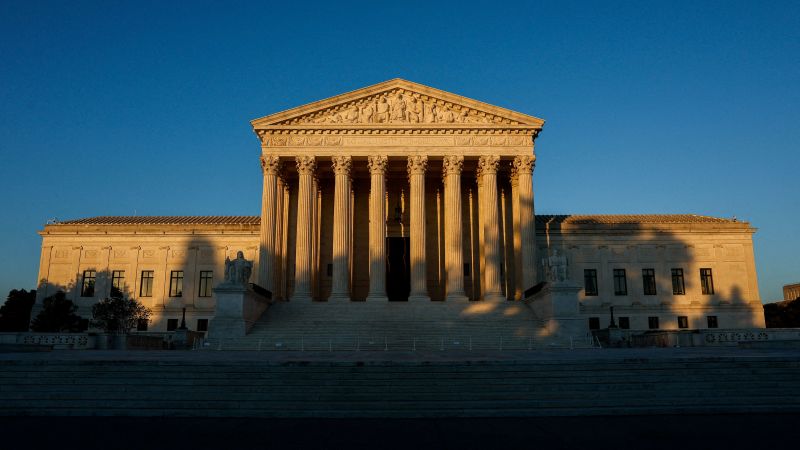
Supreme Court Set for Major Rulings Amid Political Tension
Qwenews.com – Late spring signals the Supreme Court’s approach to releasing key rulings. This term has been marked by significant decisions, including the invalidation of portions of President Donald Trump’s tariff policy, the weakening of the Voting Rights Act, and a ruling that bolstered Republican gains in the redistricting conflict he ignited. The court’s influence extends beyond legal interpretations, shaping political landscapes with its interpretations.
Political Influence and Judicial Concerns
During a recent discussion with CNN Supreme Court reporter John Fritze, the focus was on the court’s upcoming cases and the growing unease among justices about its political role. The conversation, condensed for clarity, highlights how the court is increasingly seen as a partisan entity rather than an impartial arbiter of justice.
“It’s the best time of year to be a Supreme Court reporter, when all the big cases come down,” Fritze noted. “One of the big themes this year is Donald Trump. His return to the presidency last year has led to a flurry of legal battles, with the court now addressing issues from his early term, such as the birthright citizenship case and the firing of independent officials.”
While Trump secured victories in two major rulings—such as the decision that weakened the Voting Rights Act—he faced setbacks in tariff-related cases. Fritze explained that Trump’s presence on the docket is notable, especially due to his sharp critique of the justices who ruled against him in the tariffs case. “He almost immediately called the justices who ruled against him an embarrassment to their families,” Fritze said. “Presidents often complain about Supreme Court decisions, but rarely with such personal barbs.”
Redistricting and Election Impacts
The redistricting case, which delayed the Voting Rights Act’s scope, is particularly significant. Fritze highlighted that its timing amplified perceptions of political bias. “The decision came at a critical moment, opening the court to accusations of prioritizing partisan interests,” he said. “Even liberal justices, like Ketanji Brown Jackson, have expressed concerns about how the ruling might be viewed.”
“The timing of the redistricting case raised questions about the court’s objectivity,” Fritze remarked. “It allowed Republicans to gain an edge in state elections, while Democrats in Virginia faced an unfavorable outcome. The argument that the court remains nonpartisan hinges on the diversity of cases, but the overall trend has favored Republican interests.”
Additionally, the court’s decisions on mail-in ballots could sway the upcoming election. Fritze emphasized that the justices are navigating a complex balance between legal principles and political ramifications. “There’s a growing awareness that the court’s rulings are shaping the political narrative,” he added. “The justices themselves are aware of this dynamic and its impact on public perception.”
A Fractured Judiciary
Amid the political scrutiny, justices have shown varied responses. While Jackson voiced concerns about the court’s image, Alito and Roberts have countered criticisms, defending the court’s decisions. Fritze noted, “The justices are aware of how their rulings are being interpreted, and this tension is evident in their public statements.”
As the court prepares to release more decisions, the debate over its role in American governance continues to intensify. The coming rulings may further cement its reputation as a political force, reshaping the legal and electoral landscape in the process.